
Why Hardware-Agnostic Platforms Keep TCO Predictable
In enterprise digital signage, a mixed fleet is almost unavoidable. Rollouts happen in phases, acquisitions bring in whatever screens are already installed, regions buy what’s available locally, compliance can force specific hardware or OS choices, and new use cases often have to run on older endpoints.
In a 1,000+ screen QSR deployment across India, the fleet included legacy Android versions (as old as 6.0) alongside older LG webOS SoC screens. Replacing everything to “standardize” would’ve been economically irrational, but operating them without a unified control layer would’ve turned every incident into a special case.
Without a platform that could support these legacy environments, the deployment simply wouldn’t have scaled.
Why Hardware-Agnostic Platforms Keep TCO Predictable
A hardware-agnostic CMS keeps the system stable even when hardware changes because screens and players are treated as replaceable endpoints, and core controls stay consistent: monitoring, proof-of-play, logs, remote recovery, and rollback.
Try Pickcel in your environment
This is exactly the kind of mixed estate Pickcel is built for: standardizing the operating baseline (enrollment and grouping, health signals, proof-of-play, logs, and remote recovery) so legacy pockets can stay in service, new hardware can be onboarded cleanly, and modernization happens gradually instead of as a forced refresh.
Run a hardware-agnostic pilot on your existing mix of screens and players before you commit to a full rollout.
Also read:
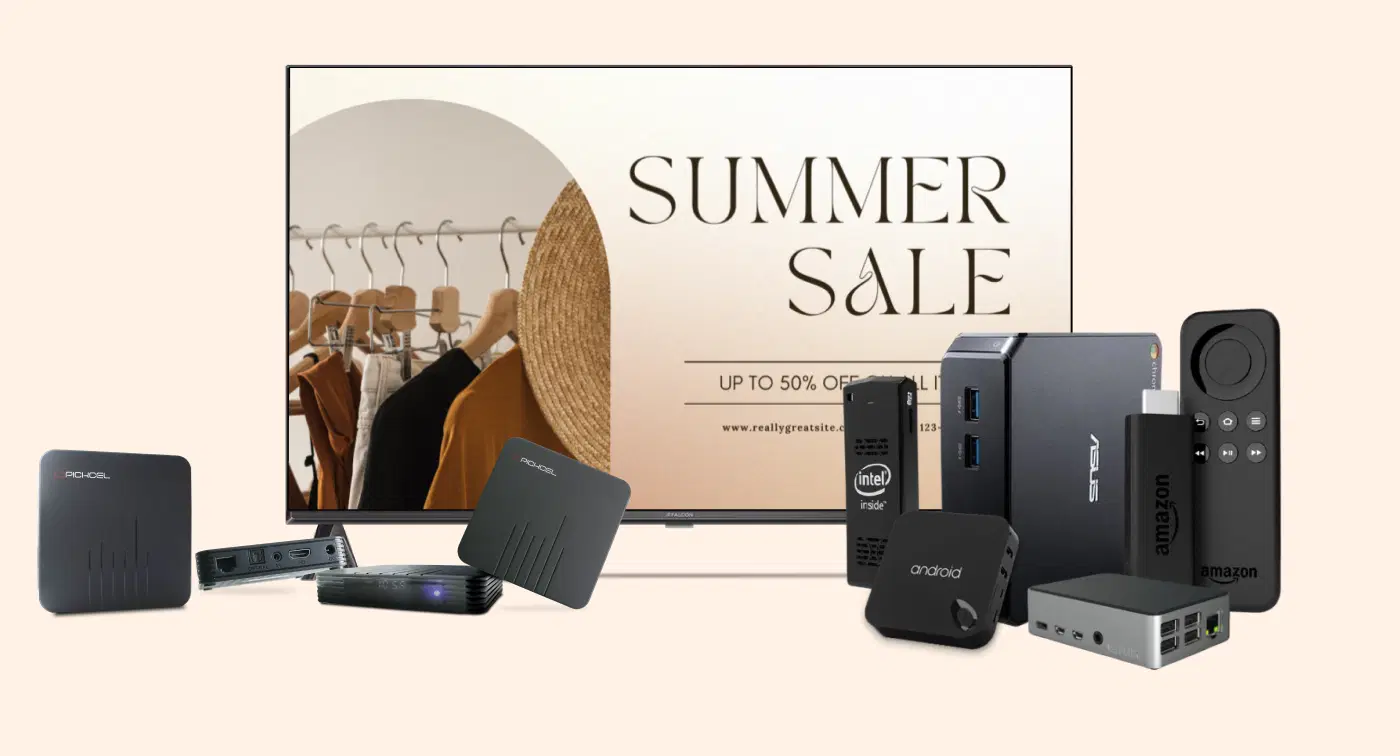
In real deployments, hardware-agnostic means the way you run and manage signage stays the same even when the hardware mix changes, across legacy Android, Tizen/webOS screens, Linux endpoints, and external players.
Why one hardware spec can’t meet every signage requirement
Old software stays in use longer than you expect
Older screens often keep working long after their built-in OS stops getting updates. So you end up managing legacy Android and older Tizen/webOS devices that you can’t justify replacing yet. Hardware-agnostic operations let you keep them running reliably while you upgrade only where it’s worth it.
New screen shapes need smarter layout control
Wide-aspect digital menu boards often need split zones and quick switches to a single full-screen view. If your platform can’t handle that cleanly, you end up running a second setup, and costs creep up.
IT and security rules can force what devices you’re allowed to use
Some enterprises mandate the endpoint OS for digital signage security and compliance, including Linux-only environments. A hardware-agnostic digital signage platform keeps you on one CMS by managing those Linux players the same way as the rest of the fleet.
Mixed OEM fleets are often the starting point
Fleets naturally become mixed because regions buy what’s available: Samsung in one cluster, LG in another, and non-standard Android devices in smaller sites. Scale gets messy when the same problem needs a different tool and a different fix depending on the screen.
Some content needs more power than built-in TV players can handle
Built-in SoC players work well for basic digital signage. But when the requirement shifts to dashboards, heavier web views, high-motion creatives, or touch, you often need an external digital signage player tier for stable performance.
In corporate deployments like Nestlé, Samsung Tizen screens were already installed, but running Power BI reliably required adding Windows or BrightSign players for the dashboard tier while keeping the Tizen screens in service. With hardware-agnostic management, all of it stays under one CMS and one consistent way to run support, so you avoid parallel systems, cut special-case fixes, and keep OpEx and refresh decisions predictable instead of reactive.
Keeping mixed-fleet TCO predictable
TCO leaks happen when failures are spotted late, the same issue needs a different fix on different endpoints, and escalations drag because ownership isn’t clear. Track what actually moves cost: issue count, time to fix, on-site visits, and repeat-problem devices by type.
To keep TCO predictable, every endpoint must support three things:
- Health visibility.
- Proof of what’s playing.
- Remote recovery with rollback.
Once the baseline is defined, classify each endpoint into one of four tiers based on two things: can it meet the baseline, and how often it creates issues.
- Keep: Devices that meet the baseline. Keep them on the standard setup and update them in planned windows so they don’t drift.
- Contain: Devices that still work but carry a higher risk, so you isolate them and limit their impact. Move them to a restricted network segment, allow-list only required CMS traffic, lock them to signage-only mode, and keep content lightweight so they don’t become frequent support tickets.
- Convert: Devices where the hardware is fine, but the OS or player layer is the liability. Rebuild them onto a supported software setup, then bring them back under the same monitoring, proof-of-play, and remote recovery workflow.
- Replace: Anything that keeps failing or can’t meet the baseline at a reasonable cost. Swap it, enroll it like the rest, and apply the same policies and recovery steps from day one.
This only works cleanly with a hardware-agnostic CMS because it treats every screen or player as an interchangeable endpoint.
Run mixed endpoints as one system
Hardware diversity is manageable as long as every screen is governable under the same control surface and the same recovery playbook.
Pickcel, a leading player in digital signage, fits this operating model because it’s built to run mixed endpoints in a single system (including Android, Windows, Linux, Raspberry Pi, BrightSign, Chrome OS Flex, LG webOS, and Samsung Tizen ). It also supports the controls that keep costs stable in real operations: offline screen alerts, proof-of-play and uptime reporting, audit logs, and remote recovery actions like rebooting the display or restarting the signage app.
If you want to turn the keep/contain/convert/replace framework into an executable plan for your fleet, connect with the Pickcel team.


Make your digital signage infrastructure easier to manage.
Unify monitoring, proof-of-play, and remote recovery across every screen - regardless of hardware.