





SOC 2 Type II Certified
Independently audited for security, availability, and confidentiality — built for IT and facilities teams signing off on vendors that sit on the network.
- Security
- Availability
- Confidentiality
Sourcing screens, media players, an installer, and signage software from four different vendors slows every rollout down. Pickcel delivers digital signage hardware, software, and deployment together, so your team manages one relationship instead of four.

Trusted by 9,000+ businesses across 70+ countries






SOC 2 Type II
ISO Certified
Digital signage hardware is the physical equipment, commercial displays, media players, mounts, and network gear, that a digital signage system runs on to display scheduled content. Most digital signage projects start with the software, then stall on sourcing that hardware. An IT manager picks a CMS, then has to separately source commercial displays, find media players that are actually compatible with that CMS, and hire an installer who has never seen the software before. When something breaks six months in, three vendors point at each other and nobody owns the fix.
The cost shows up in three places: a rollout that slips from weeks to months while procurement chases quotes from separate suppliers, a warranty and support process split across vendors with no single point of accountability, and a real risk that the media player you bought doesn't run the CMS you already licensed. None of that is a hardware problem or a software problem on its own. It is a coordination problem, and it is the reason most digital signage buyers end up managing more vendors than they expected.
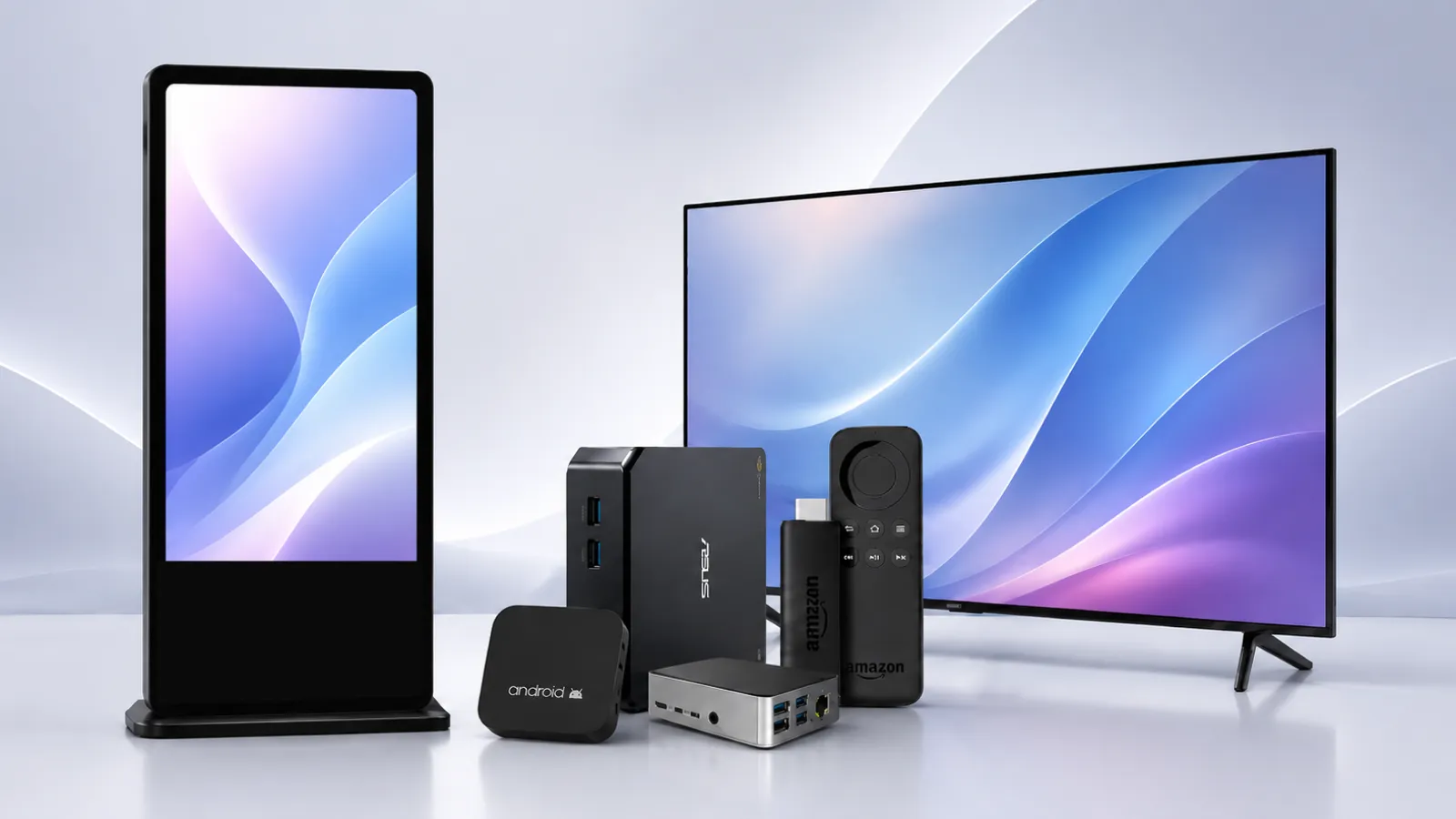
Pickcel treats digital signage hardware and software as one project, not two purchase orders. A complete rollout includes four pieces, coordinated by one team:
Commercial displays or LED
What it includes
Vetted, commercial-grade screens sized and specced for your environment
Why it matters
No guessing whether a consumer TV will survive a QSR kitchen or an outdoor kiosk
Media players
What it includes
Devices matched to Pickcel's CMS and your content mix
Why it matters
Removes the compatibility risk of buying software and hardware from unrelated vendors
Pickcel software
What it includes
Cloud CMS for scheduling, remote content updates, and multi-location management
Why it matters
The layer that makes the hardware worth installing in the first place
Installation and deployment
What it includes
Site surveys, mounting, cabling, network setup, and testing before handover
Why it matters
The part most software-only vendors leave entirely to the customer
| Component | What it includes | Why it matters |
|---|---|---|
| Commercial displays or LED | Vetted, commercial-grade screens sized and specced for your environment | No guessing whether a consumer TV will survive a QSR kitchen or an outdoor kiosk |
| Media players | Devices matched to Pickcel's CMS and your content mix | Removes the compatibility risk of buying software and hardware from unrelated vendors |
| Pickcel software | Cloud CMS for scheduling, remote content updates, and multi-location management | The layer that makes the hardware worth installing in the first place |
| Installation and deployment | Site surveys, mounting, cabling, network setup, and testing before handover | The part most software-only vendors leave entirely to the customer |
This is what "complete digital signage solution" means here: screens, players, software, and installation scoped and quoted together, so a display upgrade or a player swap two years from now still runs through the same team instead of a new procurement cycle.
Content playback breaks down more often over player compatibility than over the CMS itself. Pickcel closes that gap with certified, compatible media players, so screens run on Android or Windows players, or on the built-in system of a smart/SoC display, depending on what the site needs. For full technical detail on supported players, specs, and setup, see Pickcel's digital signage player app.
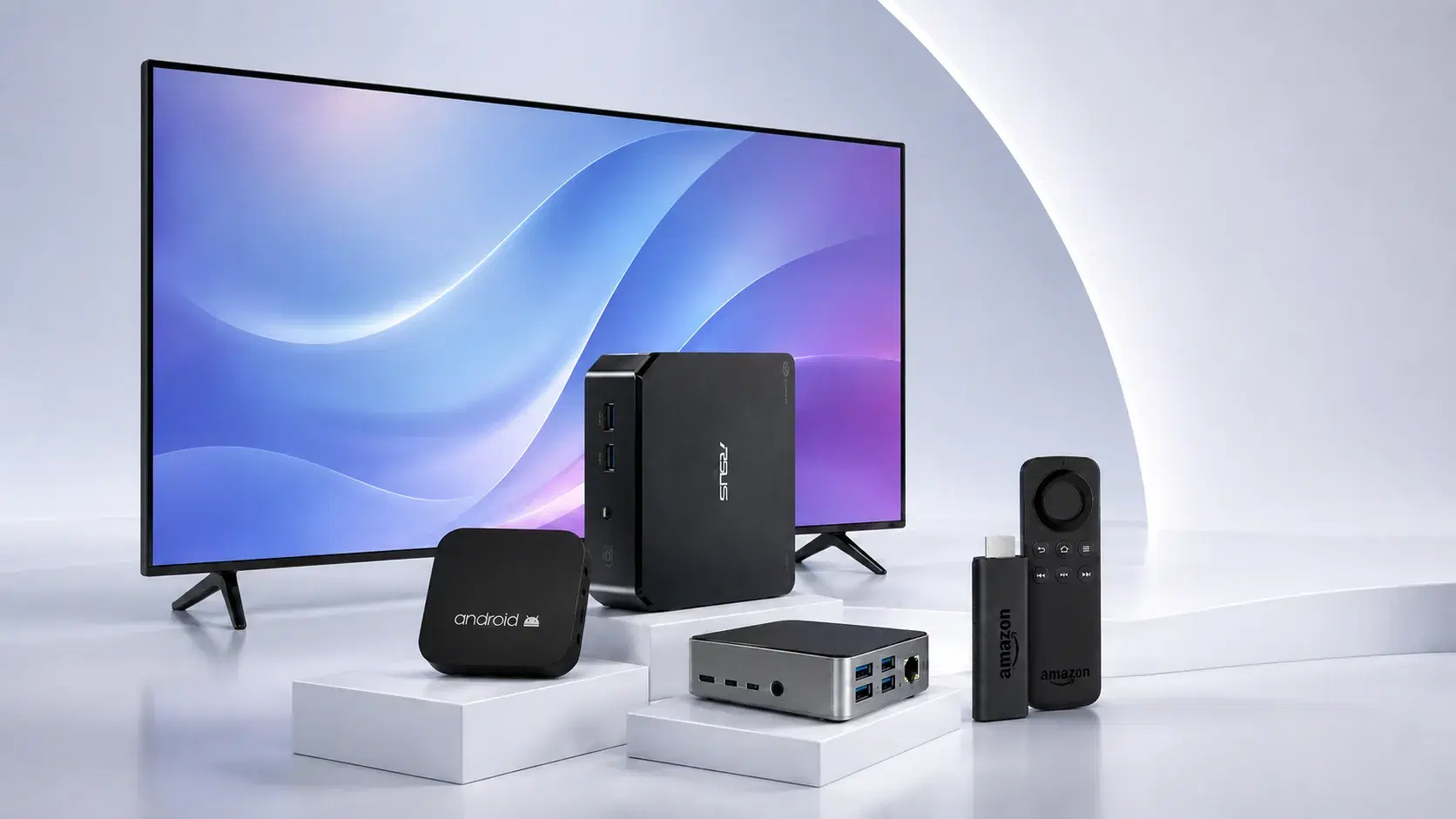
Digital signage displays fall into two broad categories: smart or SoC (system-on-chip) displays that run the CMS directly with no external player, and standard commercial displays paired with a separate media player. Smart displays reduce cabling and points of failure; standard commercial displays with an external player give more flexibility on player upgrades down the line.
Indoor commercial displays and outdoor high-brightness displays are specced differently. Indoor units are built for controlled lighting; outdoor units need higher nit ratings and weatherproofing to stay readable and durable outside. Pickcel's hardware partners help match display type and size to the site before anything ships. For sites that need two-way interaction instead of a passive display, Pickcel also supports interactive touch kiosks on the same CMS.
Screen sizing depends on viewing distance and content type
Menu board
Viewing distance
3–6 feet
Recommended size
32–43 inches
Lobby or reception screen
Viewing distance
Across a room
Recommended size
50–65 inches
Storefront window or large-format retail display
Viewing distance
Across a room or street-facing
Recommended size
75–98 inches, scaling up to an LED video wall
| Environment | Viewing distance | Recommended size |
|---|---|---|
| Menu board | 3–6 feet | 32–43 inches |
| Lobby or reception screen | Across a room | 50–65 inches |
| Storefront window or large-format retail display | Across a room or street-facing | 75–98 inches, scaling up to an LED video wall |
For lobbies, stadiums, or storefronts that need a display larger than a single panel, Pickcel supports LED video walls through its WallCraft video wall software, run on the same CMS as every other screen in the network. This page covers standard commercial displays; for video wall specs and content design, see Pickcel's LCD video wall software for standard commercial displays.
Getting hardware to a site is the easy part. Getting it mounted, wired, networked, tested, and handed over ready to run is where most digital signage installation projects lose time. Pickcel's installation and deployment process covers site surveys, mounting and cabling, network and player configuration, on-site testing, and a formal handover once every screen is live.
For a single site, that typically means each of installation service is a matter of days, not weeks, once hardware has been ordered. For a multi-site rollout across 10, 50, or 200 locations, deployment runs on a project plan with a dedicated project manager, phased site scheduling, and a consistent installation standard applied at every location, so site 40 is set up the same way as site 1. Estimated timelines vary by site count, site access, and local electrical or network readiness; Pickcel scopes an exact schedule during the quote process rather than quoting a single number that would not hold across projects.
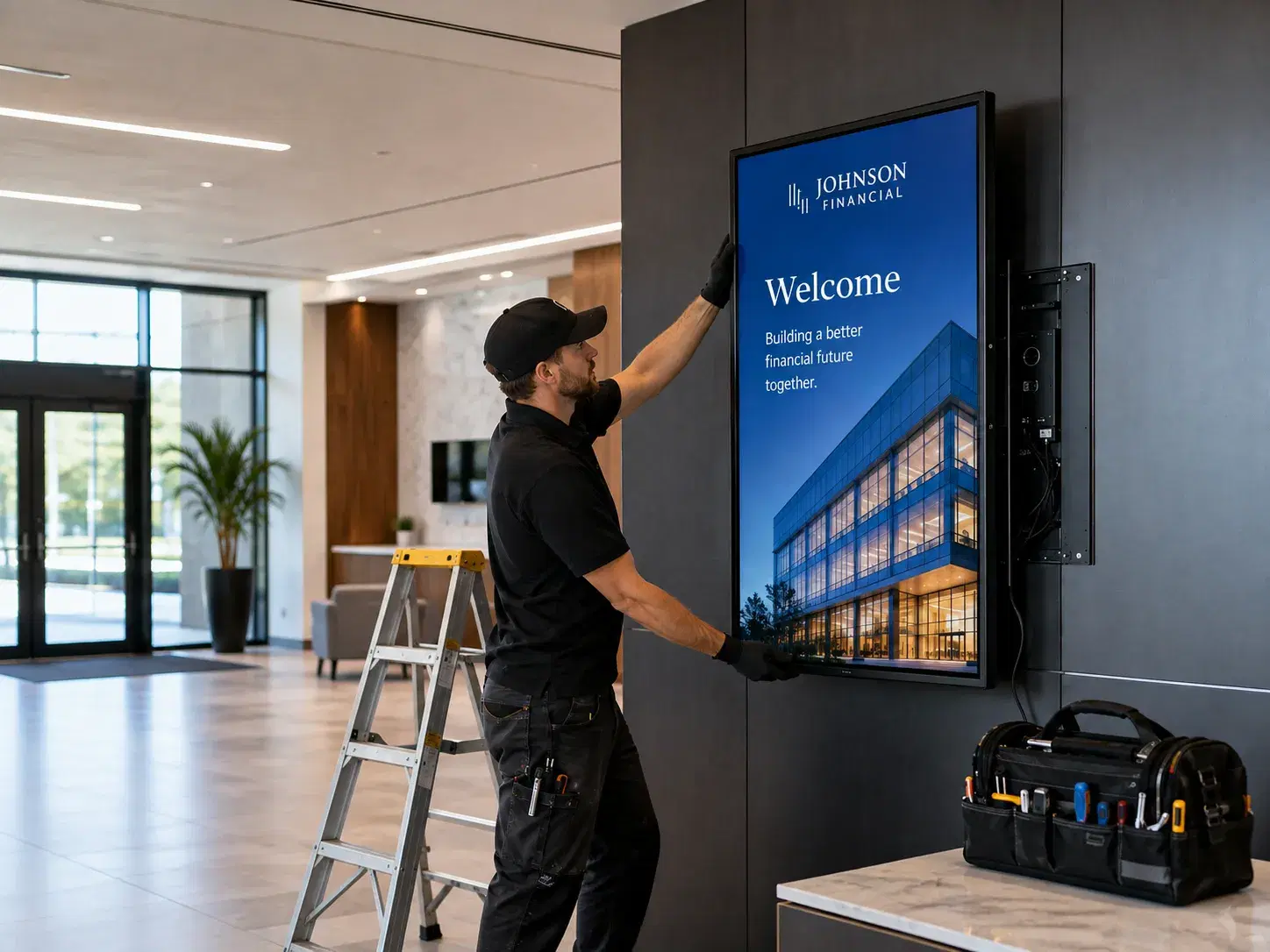
Get a scoped hardware and installation quote for your rollout in one step.
Pickcel's CMS is not locked to a single hardware brand or operating system. It runs on Android and Windows media players and on the built-in OS of most commercial smart displays, and it supports 50+ device types in total. If a site already has screens installed, Pickcel's team checks compatibility first. In most cases the existing hardware can run the CMS without a forced hardware refresh.
For the current list of supported players and operating systems, see Pickcel's supported hardware and OS pageThe same hardware-plus-software approach applies across QSR drive-thrus and menu boards, retail storefronts and in-store promotions, healthcare waiting rooms, corporate lobbies and internal comms, banking branches, transit hubs, and government facilities. Screen types, sizing, and installation specifics differ by environment; Pickcel's industry and use-case pages cover the specifics for each one.
Airport and transit-hub deployments typically pair this hardware with Pickcel's FIDS software for airports to manage gate and flight status displays.
Pickcel is SOC 2 Type II and ISO 27001 certified, which matters when IT is the one signing off on a vendor with access to the network these screens sit on. Beyond the software platform (Pickcel's digital signage software), the company runs digital signage for 9,000+ businesses across 70+ countries, spanning single-site retailers to global, multi-location enterprises.
Independently audited for security, availability, and confidentiality — built for IT and facilities teams signing off on vendors that sit on the network.
The global standard for information security management. Certified controls across systems, processes, and data protection.
From single-store retailers to global enterprises, 9,000+ businesses trust Pickcel in 70+ countries.
Ready to scope your hardware rollout?
Get screens, players, software, and installation quoted together.
"Working with one team for the screens, the software, and the install meant we didn't have to chase three vendors when something needed fixing."
Marketing team
Nissan Motor India Private Ltd. · Automotive · India · 200+ screens
For a broader look at how Pickcel operates as a vendor, not just a software product, see Pickcel's company page.
Commercial displays and LED are not built by Pickcel. They are sourced and installed through vetted regional hardware partners, selected and managed by Pickcel for each project.
The software and platform, the part that schedules content, manages devices remotely, and keeps every screen in sync, is built and owned by Pickcel.
This split is by design: it lets Pickcel choose the best-fit display and installer for each site rather than pushing customers toward one manufacturer's hardware.
Our team is here to help with anything not covered above.