
Digital Signage Kiosk Software for Every Industry
Managing interactive kiosks and passive display screens on separate platforms adds operational complexity your team doesn't need. Pickcel runs both from a single cloud dashboard, across Android, Windows, Linux, Chrome OS, and Raspberry Pi, with full remote management from any browser.

Trusted by 9,000+ Businesses Globally




















What Is a Digital Signage Kiosk?
A digital signage kiosk is an interactive touchscreen display that combines content playback with user-triggered actions, such as wayfinding, product lookup, check-in, or feedback collection, all managed remotely from a cloud platform.
A standard digital signage screen delivers a content loop and accepts no user input. A digital signage kiosk adds a touch layer, workflow logic, and often form-based interaction, while remaining connected to the same content management infrastructure as your other screens.
The distinction matters operationally. Organisations that deploy both screen types typically find themselves managing two content pipelines, two device inventories, and two support escalation paths. Pickcel resolves this by treating all screen types, passive displays and interactive kiosks, as the same class of managed device, with the same dashboard, the same scheduling tools, and the same device health monitoring.
For a broader overview of kiosk deployment models, see our kiosk digital signage guide.
The Problem With Most Interactive Kiosk Software
Operations and IT teams deploying kiosks across multiple locations face the same problems repeatedly.
Platform Fragmentation Across Operating Systems
A retail estate with Android tablets at entrances, Windows terminals at service points, and Chrome OS devices in fitting rooms requires three separate kiosk platforms, three license agreements, and three support workflows. When a device fails, the team must first identify which system manages it before they can act.
No Remote Visibility Into Device Health
A kiosk that stops responding in an out-of-town branch goes unnoticed until a customer reports it. Without live device monitoring in a central dashboard, fault resolution is reactive, and a non-functional kiosk at peak hours in a transport hub or hospital creates disruptions that compound quickly.
Content Pipelines Disconnected From the Rest of Your Signage
Kiosk content, whether a wayfinding map, a self-service menu, or a check-in form, typically lives outside the main signage CMS. Updating it means physical device access or a separate portal, creating version-control problems that grow with every additional location.
Security Gaps on Customer-Facing Deployments
Kiosks that handle personal data or sensitive content are subject to security expectations that standard signage platforms weren't built for. Healthcare, banking, and government deployments face explicit compliance requirements that most kiosk software treats as the exception, not the baseline.
How Pickcel Solves It: Problem-to-Capability Mapping
| Problem You Have Today | How Pickcel Handles It | What You Get |
|---|---|---|
| Separate kiosk and signage management systems | Single cloud CMS for all screen types | One system, one training overhead, one support contract |
| OS fragmentation: Android, Windows, Linux, Chrome OS, Raspberry Pi across sites | Native apps on all five OS platforms | Full device fleet managed from one dashboard, regardless of hardware |
| No real-time visibility into offline or failing devices | Live device health monitoring with status alerts | Proactive fault resolution before visitors encounter disruption |
| Content updates require on-site visits or separate portals | Cloud-based scheduling and push deployment | Real-time content changes from any browser, at any location |
| Customer-facing kiosks need security and access controls | SOC 2 Type II + ISO 27001 + role-based access + lockdown mode | Audit-ready kiosk environments that meet enterprise and regulated-sector requirements |
Information, Advertising, Retail, Healthcare, Self-Service, Wayfinding, Gaming and Entertainment, Feedback Collection — no custom development required for standard deployment types.
Android, Windows, Linux, Chrome OS, Raspberry Pi — native support across all five major kiosk OS environments.
Use Pickcel to manage screens across retail, healthcare, transport, corporate, and hospitality globally.
Capability Highlights
Remote Kiosk Management
Pickcel lets you update, reboot, and monitor any kiosk from your browser, at any hour, from any location, without requiring physical access to the device.
Push content updates to individual devices or device groups, restart screens remotely, and check online/offline status in real time. The dashboard shows each device's current status, last heartbeat, and content sync state, so a national IT team can manage a kiosk in a regional store with the same controls and response time as a local unit.
Kiosk Lockdown
Pickcel's kiosk lockdown mode restricts the device to a single app or an approved content set, preventing visitors from accessing the underlying OS, other applications, or the open browser.
Staff cannot accidentally dismiss kiosk mode: hardware button combinations that would normally exit an app are suppressed, and the approved content and permission set can be updated remotely. For regulated environments, lockdown is documented as a security control in compliance audit reports.
Multi-Platform OS Support
Pickcel kiosk software runs natively on Android, Windows, Linux, Chrome OS, and Raspberry Pi, the broadest OS support available in the interactive kiosk software category.
The support is native, not emulated: each OS has a purpose-built Pickcel app with full lockdown, offline playback, device health reporting, and push content sync. Hardware choices are never constrained by software limitations.
Fast Offline Access
Content cached locally on the device plays back without interruption when the internet connection drops. No error screen. No frozen display.
When connectivity returns, the device re-syncs automatically and incrementally, downloading only changed assets. This matters most in basements, underground transit stations, and rural sites where a kiosk error screen in a hospital corridor or airport terminal is a reputational failure.
Pre-Built Kiosk Applications
Over 10 pre-built kiosk application templates cover visitor registration, wayfinding, queue management, feedback collection, product lookup, event scheduling, and appointment booking, each configurable in the CMS without custom development. For unique workflows, the Pickcel API supports custom application and CRM/POS integration deployed through the same interface.
Touch Interface
Single-touch and multi-touch gestures work on certified touchscreen hardware, configurable per device: a high-traffic retail kiosk can use large tap targets for casual visitors, while a corporate self-service terminal supports a more complex navigation structure. For deployments focused on non-kiosk interactive touchscreens, see Pickcel's interactive display software.




See how Pickcel manages every kiosk and screen from one dashboard.
20-minute walkthrough. No obligation.
Security and Compliance for Customer-Facing Kiosk Environments
SOC 2 Type II
Operational security controls, independently verified
ISO 27001
Information security management, independently audited
Role-based access control: content managers, regional administrators, and IT staff each operate within defined, auditable permission boundaries.
Remote wipe capability allows device decommissioning without physical access, critical for devices that are compromised or closed at a location.
Complete audit trail: all CMS actions, including content changes, user access events, configuration changes, and device reboots, are logged with timestamps and user attribution.
Pickcel's infrastructure does not store visitor interaction data from kiosk sessions by default; custom data capture via API is subject to your own privacy controls and data residency requirements.
8 Kiosk Types Ready to Deploy
Pickcel supports eight interactive kiosk types through pre-built application templates. No custom development is required for standard deployments. All eight types run from the same cloud CMS.
Information Kiosks
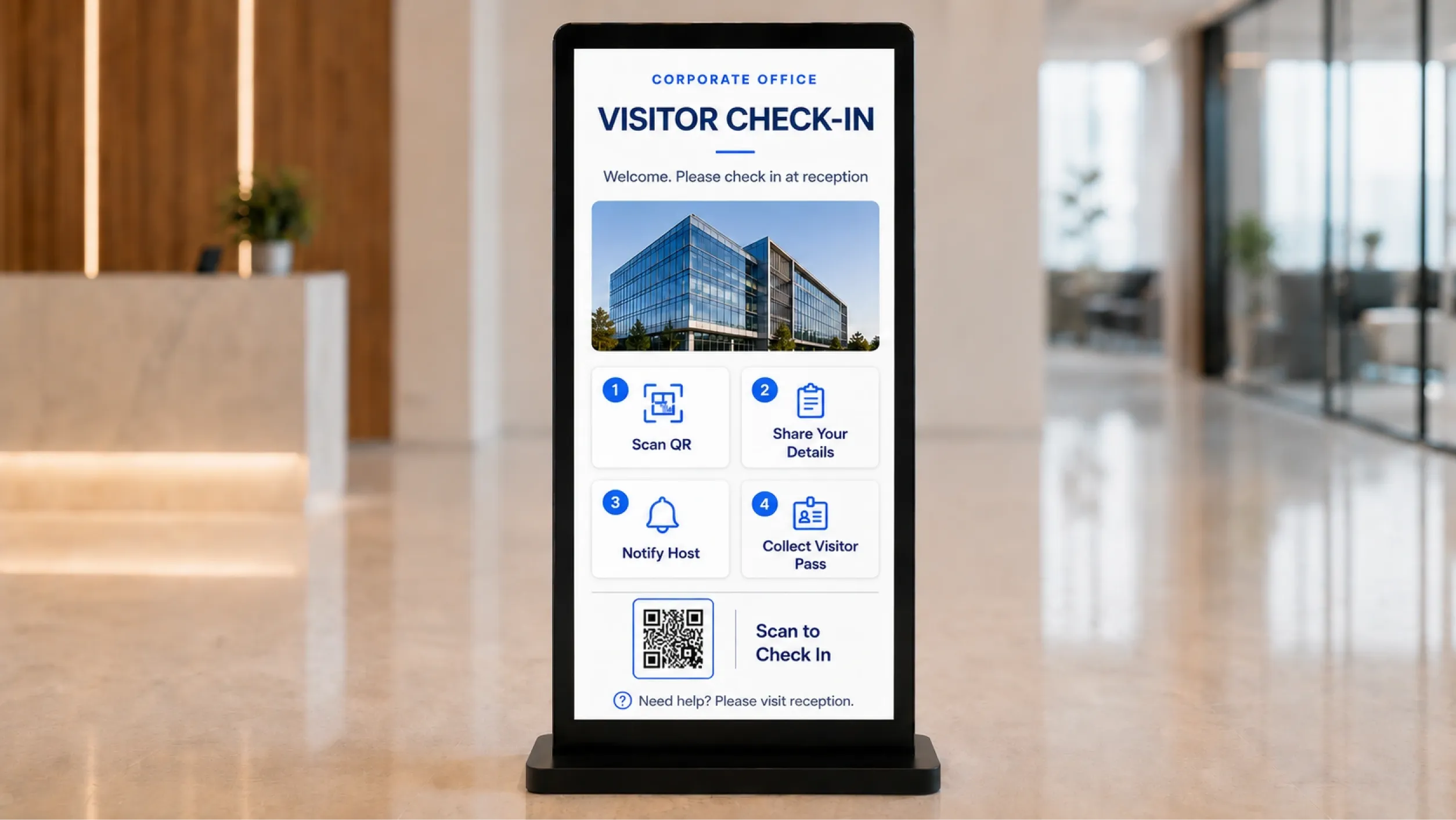
Static or dynamic information displays for lobbies, transit hubs, government offices, and public spaces. Content updated remotely via scheduled push, with health monitoring and offline playback fully cloud-based. For a detailed deployment guide, see information kiosks in public spaces.
Advertising Kiosks
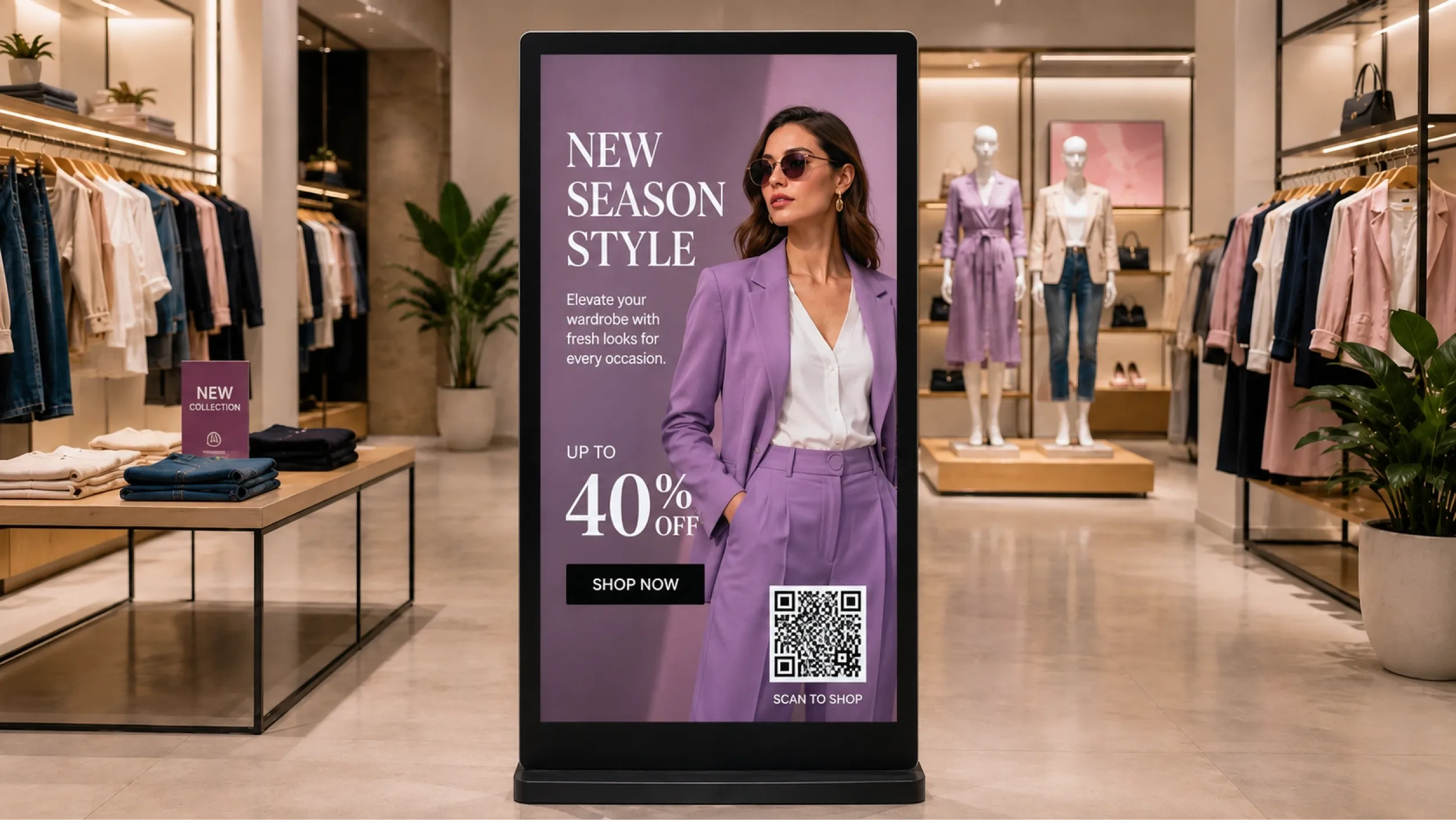
Interactive digital advertising with touch-triggered content depth, QR code integration, and interaction logging, so advertising responds to visitor interest rather than following a passive loop.
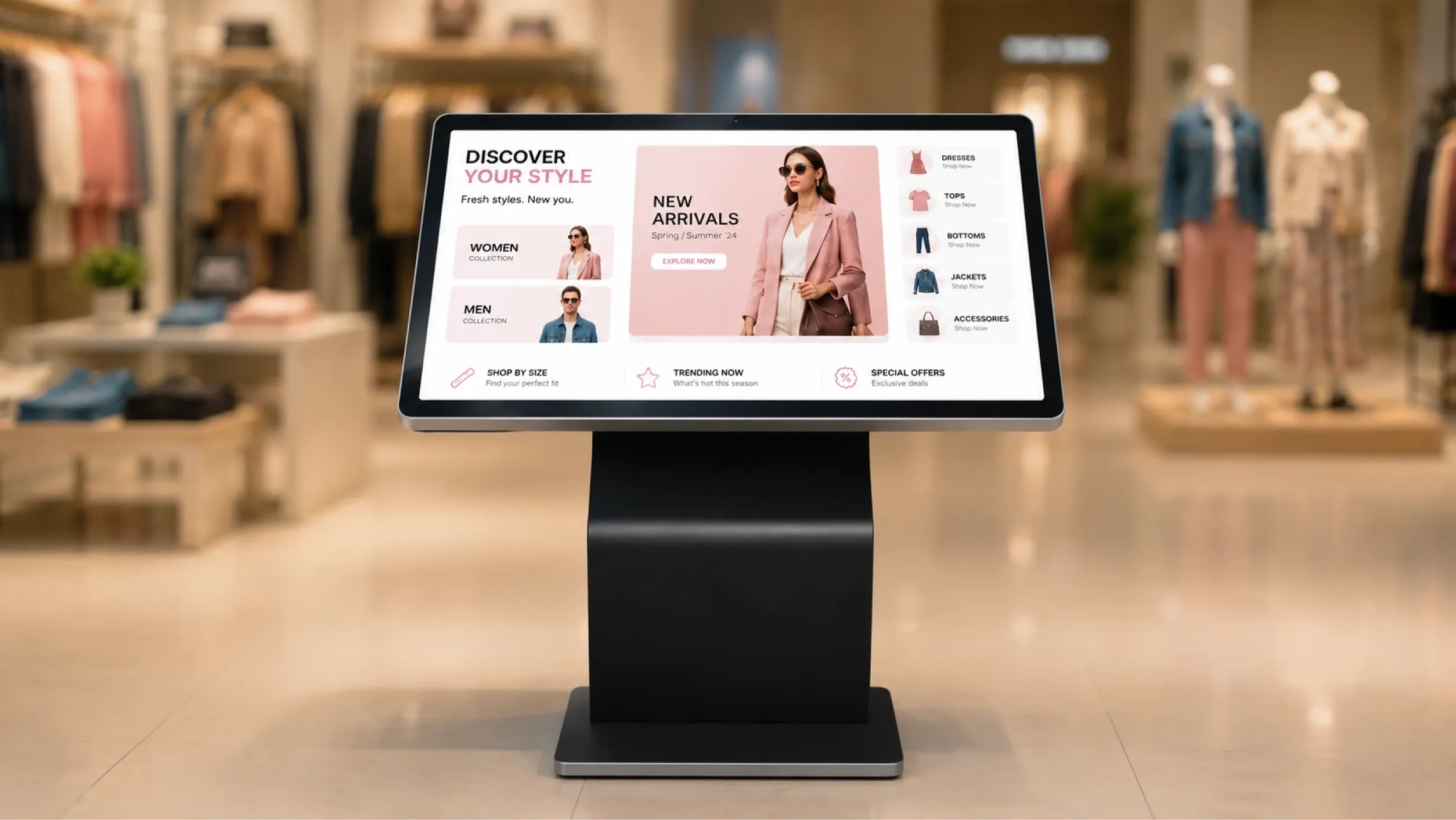
Retail Kiosks
Product catalogue browsers, stock check tools, and assisted selling interfaces that connect to POS and inventory systems via API, enabling self-guided product discovery during peak hours.
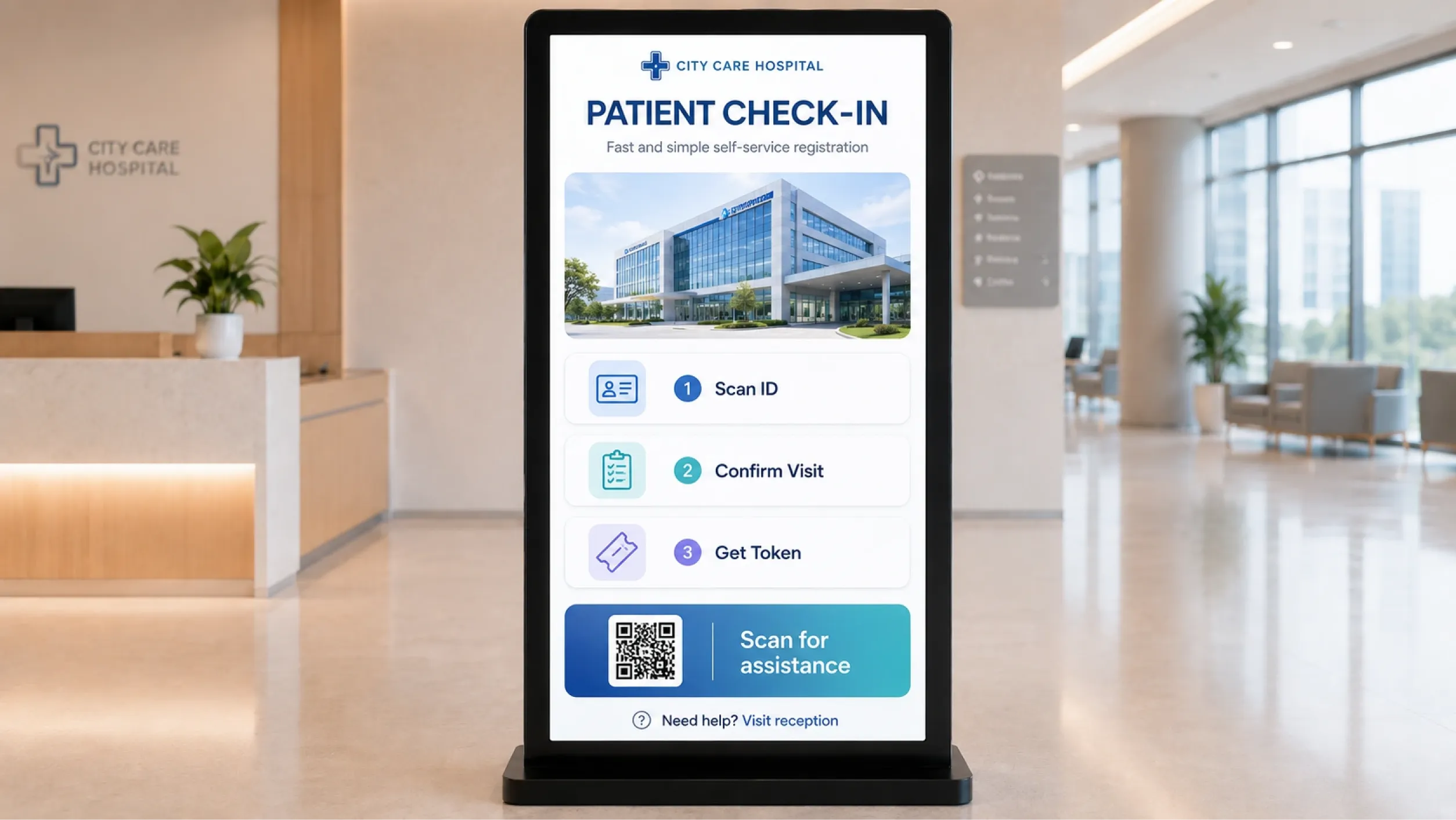
Healthcare Kiosks
Patient check-in, appointment confirmation, and wayfinding for hospitals and clinics, with configurable interface hygiene protocols: automatic content refresh and session timeout.
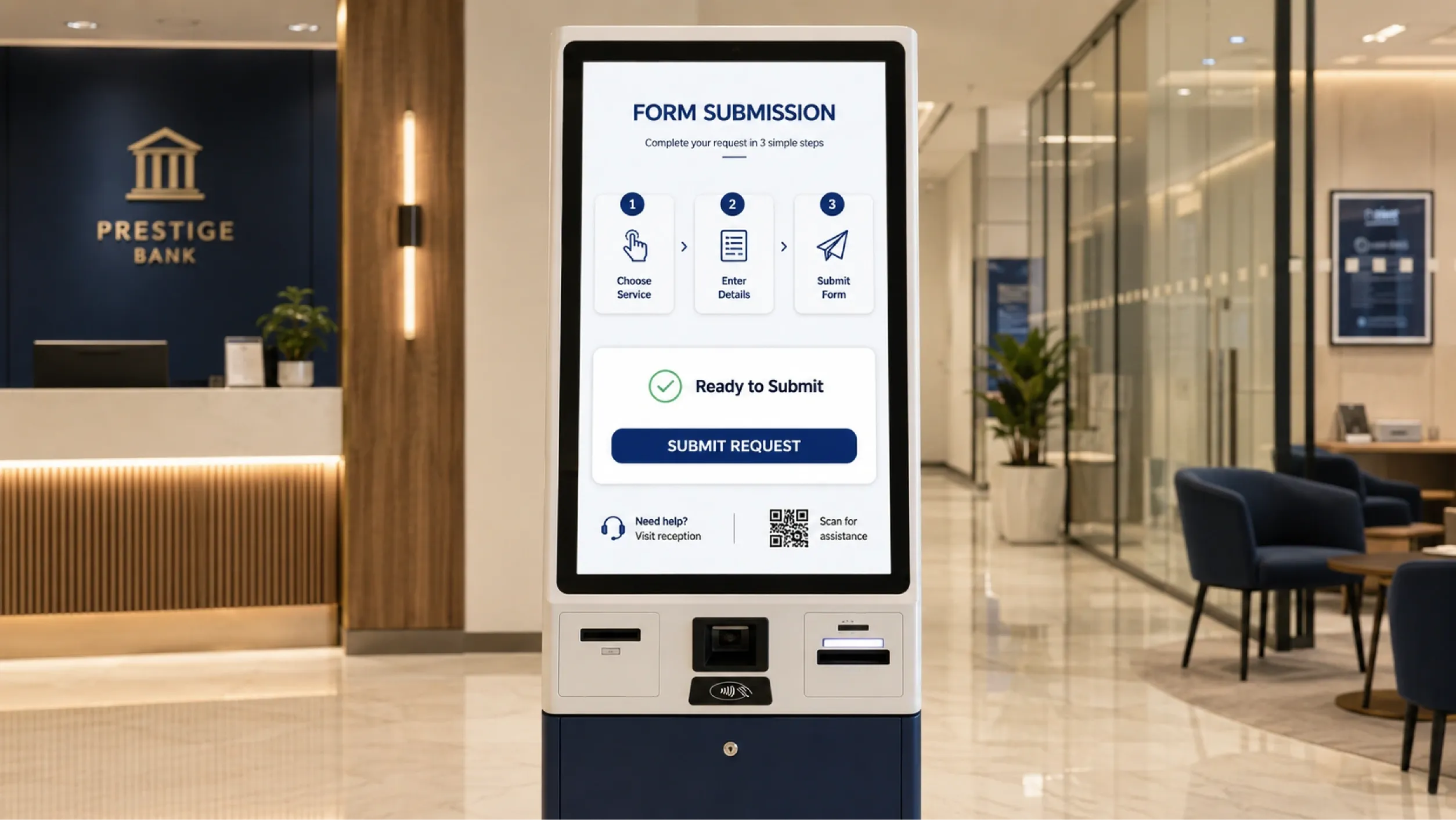
Self-Service Kiosks
End-to-end workflows for banking, government, utilities, and insurance: form submission, identity verification trigger, queue ticket issuance, and appointment booking. See Pickcel's digital signage kiosk visitor management application for visitor registration workflows specifically.
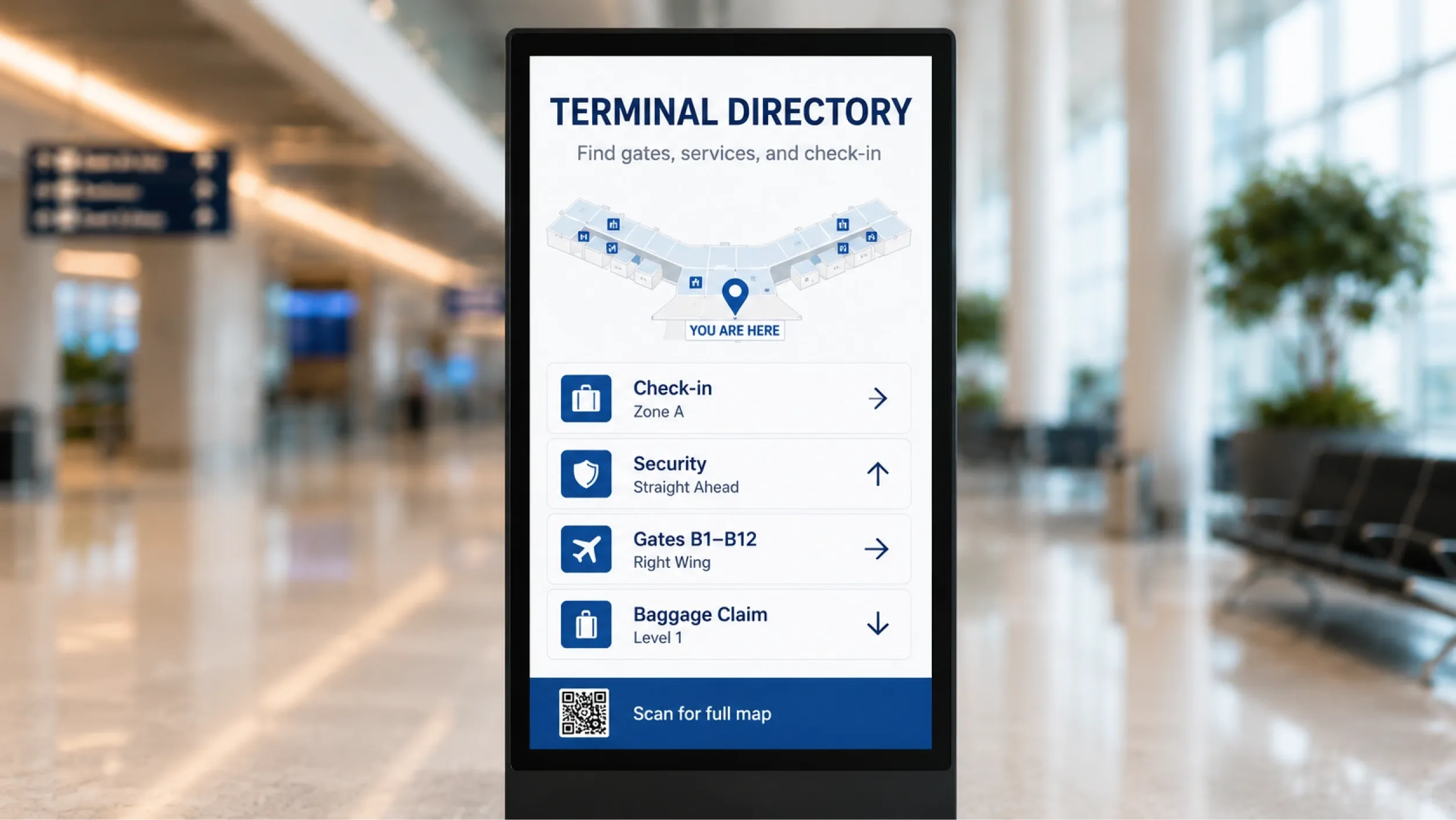
Wayfinding Kiosks
Interactive maps for campuses, hospitals, airports, and large retail destinations, with floor plan overlays and point-to-point navigation configurable without custom development. See Pickcel's wayfinding signage software for enterprise deployments beyond kiosks.
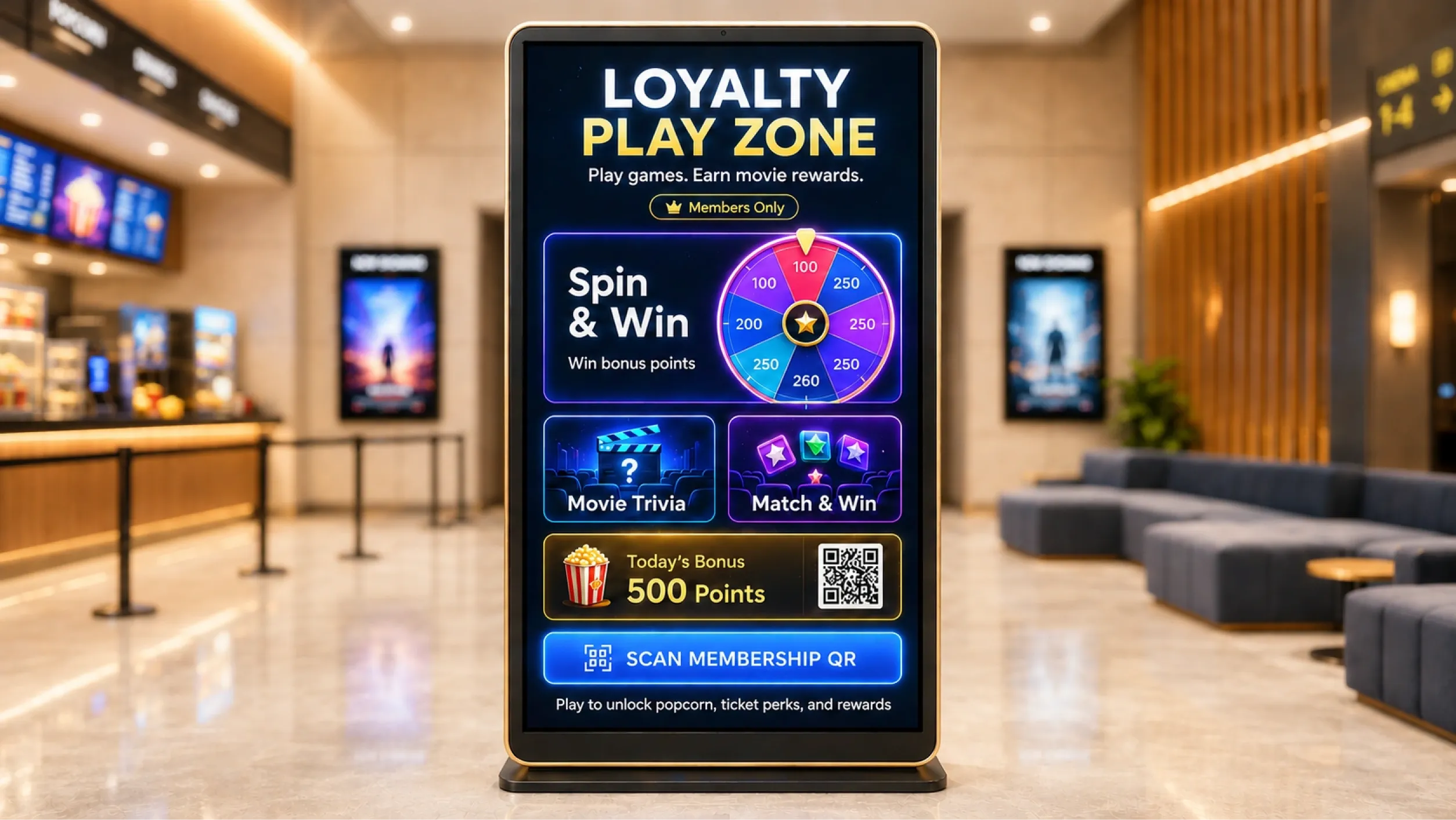
Gaming and Entertainment Kiosks
Loyalty programme games, brand activations, and experience-based content for QSR chains, cinemas, and entertainment venues, updated seasonally or by campaign period from the central CMS.
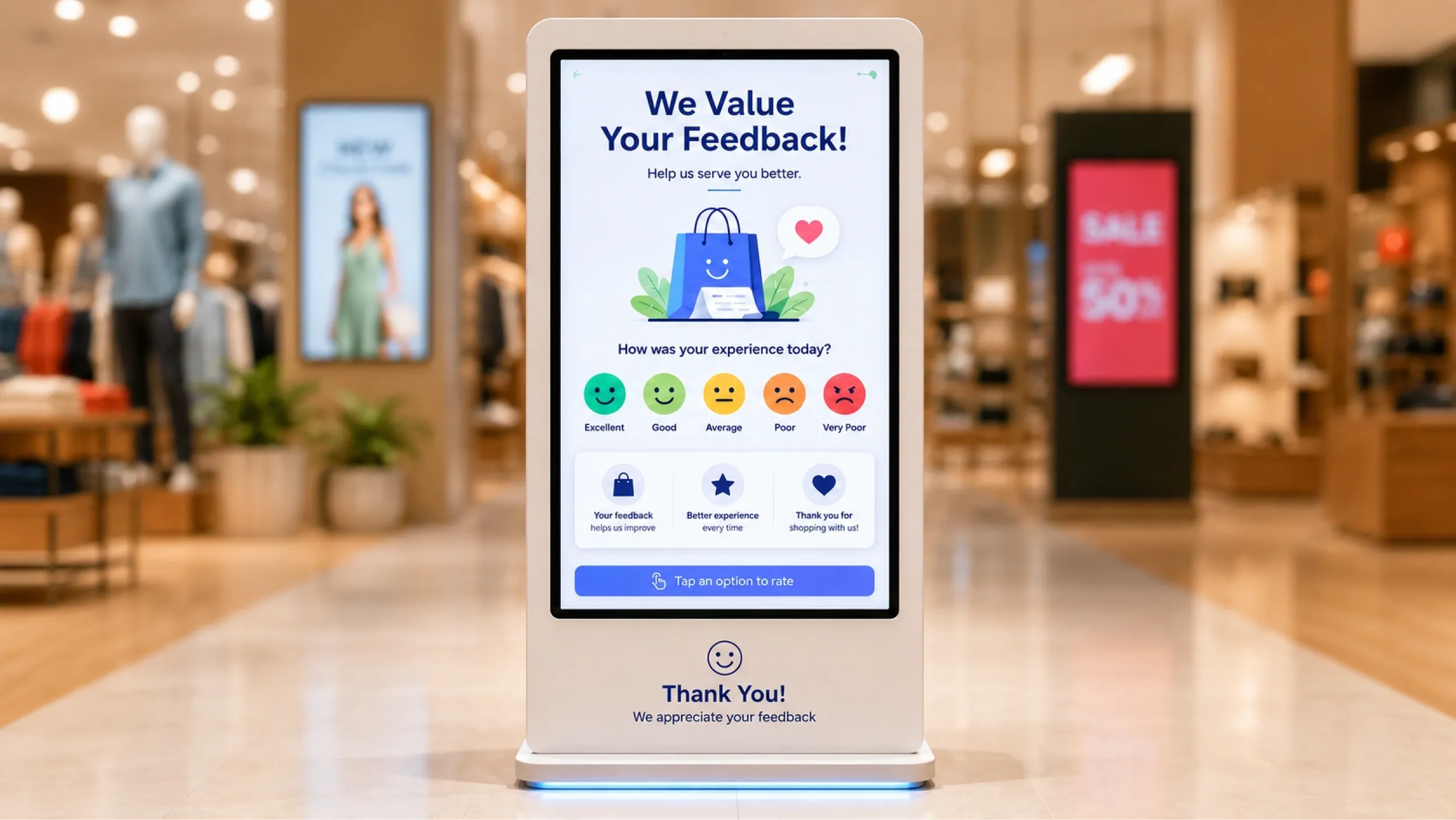
Feedback Collection Kiosks
Post-service satisfaction surveys, NPS prompts, and structured complaint logging, exportable to CRM or analytics platforms via API to flag where service experience diverges from standard.
From Decision to Live in Three Steps
Connect Your Devices
Create your Pickcel account and install the app on your kiosk hardware, whether Android tablet, Windows terminal, Linux device, Chrome OS display, or Raspberry Pi. The device appears in your dashboard within minutes. No professional services engagement required.
Configure Content and Kiosk Settings
Choose a pre-built kiosk template or upload your own, set lockdown permissions, assign the device to a location group, and schedule content rotations, all from the CMS browser interface with no command-line or device-side configuration.
Monitor and Manage Remotely
Check device status, push content updates, restart devices, review interaction logs, and add new locations from the same dashboard. Scaling from five kiosks to five hundred uses the same operational model.
Return on Investment: Where the Numbers Come From
The return on an interactive kiosk deployment comes from two directions.
Operational cost reduction
Centralised remote management reduces the frequency of site visits required for content updates and device maintenance. The impact is most pronounced for fleets of 20 or more units at dispersed locations, where the cost of physical access per device accumulates quickly.
Revenue and throughput uplift
Self-service kiosks in retail and hospitality expand transaction capacity at peak hours when staffing is constrained. Queue reduction through self-service check-in kiosks in healthcare and government settings frees administrative staff time for higher-value tasks.
The ROI case is strongest for operations with three or more locations, regular content update requirements, and OS diversity across their device fleet.
Customer Story: Asian Paints
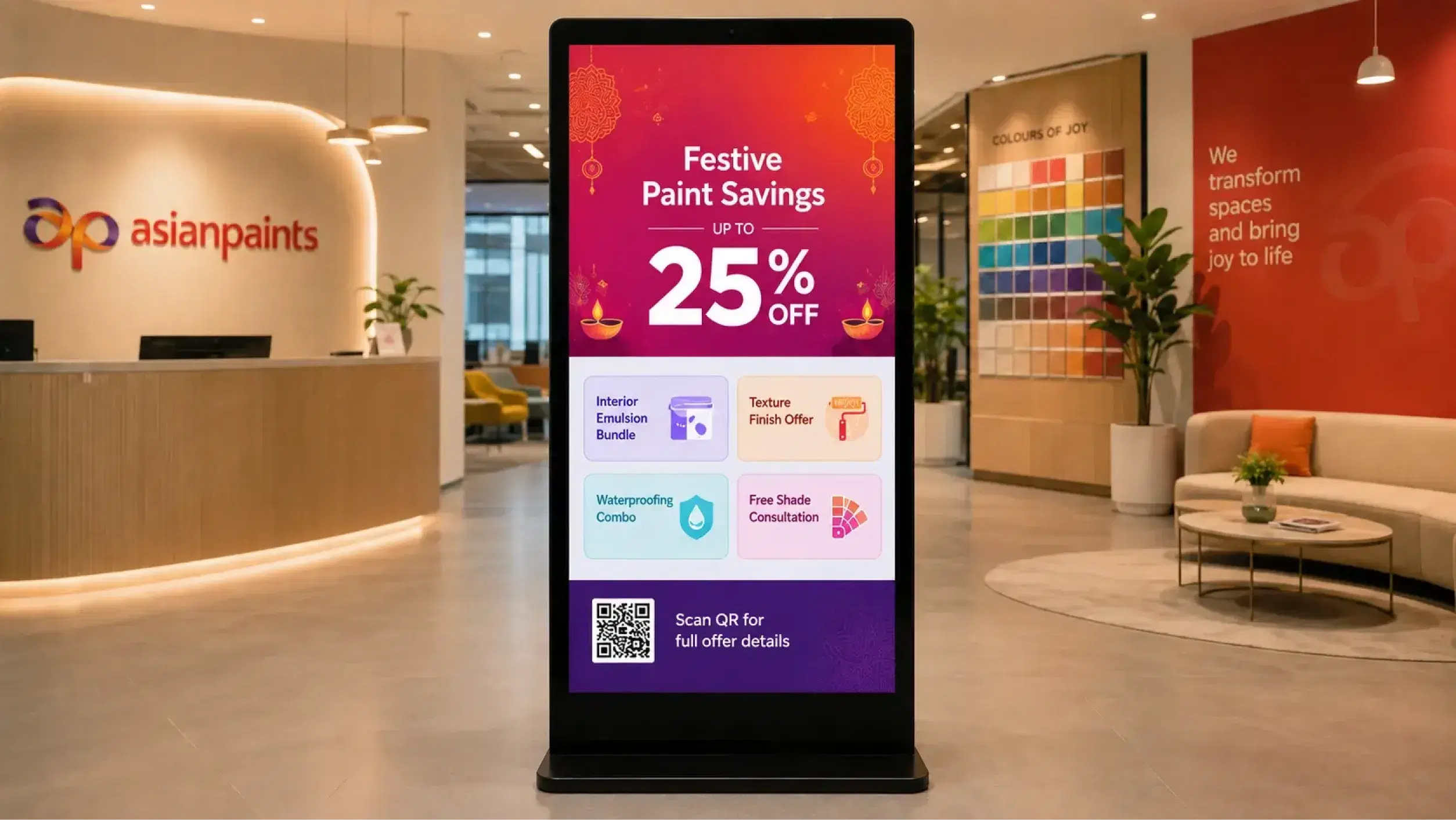
Asian Paints deployed Pickcel across their retail network to manage both passive display screens and interactive kiosks from a single platform. Their operations team manages content updates and device monitoring centrally, without requiring site visits for routine changes.
The platform's multi-location management capability and remote monitoring tools were key to the deployment decision: Asian Paints needed a solution that could scale with their distribution network without proportional growth in operational overhead.
Why Operations Teams Choose Pickcel for Kiosk Software
One platform for every screen type.
The same digital signage software manages passive display screens, interactive kiosks, and digital menu boards. No parallel systems, no duplicate training, no separate support escalation paths.
Broadest OS support in the category.
Android, Windows, Linux, Chrome OS, and Raspberry Pi are all supported natively, so an existing mixed-OS estate never requires hardware replacement to standardise on Pickcel.
Remote management at any fleet size.
From five kiosks to five thousand, the operational model doesn't change: add locations, assign content, change lockdown settings, and monitor device health from the same dashboard.
Enterprise security as standard.
SOC 2 Type II and ISO 27001 certifications, kiosk lockdown, role-based access control, and a full audit trail are included for all customers, not as an enterprise supplement.
Extensible through API.
Pickcel connects to CRM, POS, queue management, HR, and analytics platforms via API, with pre-built connectors reducing development time for common integrations.
Deployment without professional services.
Standard kiosk deployments are configured and live within 30 minutes per device using the CMS browser interface, with no on-site technical resource required.