
On-Premise Digital Signage Software: Full Control, Zero Cloud Dependency
Deploy Pickcel on your own infrastructure. Manage screens across locations without routing data through third-party servers. Built for secure, regulated, and air-gapped environments.No commitment required. Our specialists will walk you through deployment options for your specific environment.

Trusted by businesses worldwide





ISO 27001
SOC 2 Type II
SSO / MFA
Air-gap ready
Offline playback
Pickcel Digital Signage: Scale and Reliability
What Is On-Premise Digital Signage Software?
On-premise digital signage software is a screen management platform installed on infrastructure owned and operated by the organisation. All content, usage data, and device telemetry remain within the organisation's own network, with no dependency on external servers for content delivery. Pickcel's on-premise deployment provides the same scheduling, multi-screen management, and real-time updates as the cloud edition, running entirely within your own network perimeter. It is designed for organisations with data residency obligations, network isolation requirements, or air-gapped environments where cloud connectivity is restricted or prohibited. Pickcel is trusted by 9,000+ businesses across 70+ countries, manages more than 150,000 screens worldwide, and holds ISO 27001 and SOC 2 Type II certifications, with on-premise deployment supported as a first-class option alongside its cloud platform.
Why Cloud-Based Digital Signage Does Not Work for Every Organisation
Some organisations have requirements that cloud-based platforms cannot meet. These are not edge cases. They are structural constraints that arise from regulatory obligations, network architecture, or internal security policy. Three of the most common:
Regulatory requirements prohibit external data processing
Government agencies, defence contractors, pharmaceutical companies, and financial institutions operating under sector-specific compliance frameworks are often required to keep operational data within their own network perimeter. A cloud-based signage platform routes all content, scheduling commands, and device telemetry through the vendor's external servers. That configuration fails these requirements before a single screen is deployed.
Air-gapped and restricted networks have no cloud path
Facilities that operate on isolated networks — defence sites with classified infrastructure, manufacturing plants running alongside SCADA systems, hospital wards with segregated IT environments — cannot rely on outbound internet connectivity for digital signage to function. A platform that requires a constant upstream connection cannot operate in these environments, regardless of feature quality.
Data sovereignty obligations extend to signage
Organisations subject to data protection regulations or sector-specific governance requirements must demonstrate that all data generated within their network stays within their network. When a cloud vendor processes signage data on servers outside the organisation's jurisdiction, meeting that obligation becomes significantly harder. On-premise deployment keeps data inside the perimeter from the first content upload to the last playback log.
How Pickcel's On-Premise Platform Addresses Each Constraint
Here is how Pickcel's digital signage platform addresses each constraint:
| Problem you have today | How Pickcel handles it | What you get |
|---|---|---|
| Signage data must not leave your network | Pickcel server installs on your own hardware; all content and logs are processed and stored internally | Full data sovereignty: no external API calls during content delivery |
| Your facility runs on an isolated or air-gapped network | Content delivery operates over LAN or Wi-Fi; offline playback continues without any internet connection | Reliable screen operations with no upstream internet dependency |
| IT requires Active Directory or SSO for user management | Azure AD, Okta, and LDAP integration are built into the on-premise admin panel; MFA is included | Existing enterprise identity management extends to signage without a separate credential system |
| Compliance requires audit trails and access controls | Role-based access control with full audit logs covering every administrative action | An auditable access record that supports internal governance and regulatory reviews |
| Content management must remain within your own infrastructure | The Pickcel admin dashboard is locally hosted; all scheduling, publishing, and device management happens on your network | Complete screen management with no third-party infrastructure dependency |
Three Steps to On-Premise Deployment
Install Pickcel server on your hardware
Deploy on bare-metal, VM, or private cloud within your network perimeter.
Connect screens over your local network
Pair commercial displays and media players over LAN or Wi-Fi.
Manage content from the local admin dashboard
Schedule, publish, and monitor screens from your locally hosted CMS. Before you go live, review the full on-premise deployment checklist for network configuration, device provisioning, and pre-launch verification steps.
Key Capabilities for On-Premise Deployments
Pickcel's on-premise deployment includes six capabilities purpose-built for secure, isolated, and compliance-driven environments.
Local Server Deployment
Pickcel installs on your own bare-metal hardware, virtual machine, or private cloud environment — including AWS, Azure, or GCP with VPC peering. Your IT team controls the server, the operating environment, and the update schedule — so you can run digital signage management entirely within infrastructure you own and operate.
Active Directory and Azure AD Integration
The admin panel supports single sign-on via Azure AD, Okta, and LDAP. Multi-factor authentication is included. User accounts, access levels, and authentication policies are managed through your existing enterprise identity platform — so you can extend your existing enterprise identity management to digital signage without a separate credential system.
Offline Playback
Screens pull scheduled playlists to local storage. Playback continues automatically during network disruptions or admin server downtime, with no manual intervention required — so you can keep screens running as scheduled regardless of upstream connectivity.
Air-Gap Mode
In fully isolated deployments, all content delivery and device communication operate over your internal network with no outbound internet traffic. This configuration is suitable for classified facilities, high-security government sites, and environments adjacent to operational technology systems — so you can deploy signage in environments where no outbound internet traffic is permitted.
Audit Logs and Role-Based Access Control
Every administrative action in the Pickcel dashboard is logged by user, timestamp, and operation type. RBAC policies control which users can view, edit, or publish content across different screen groups and locations — so you can maintain an auditable access record that supports internal governance and regulatory reviews.
50+ Device Compatibility
Windows, Linux, Android, BrightSign, Samsung Tizen, LG webOS, and Raspberry Pi are all supported. Commercial display hardware from major manufacturers connects without proprietary players — so you can preserve existing hardware investments across the transition to a new signage platform.
See it in 20 minutes
See Pickcel's on-premise deployment in a 20-minute walkthrough. Our specialists will configure the demo around your infrastructure and compliance requirements.
No commitment required. Prefer to talk first? Talk to an on-premise specialist.
Loading form...
On-Premise Digital Signage at Scale: FFG

Flensburger Fahrzeugbau Gesellschaft mbH (FFG) is a German defence and military vehicle manufacturer with a 150-year operational history, 900 employees, and a global presence across more than 40 countries. Their requirement was specific: a unified on-premise digital signage platform capable of operating across multiple facilities while keeping all data within their own infrastructure and meeting the security expectations of a defence contractor.
Pickcel deployed its on-premise platform across FFG's operations, covering centralised system design, real-time data integration, and internal operational visibility. The deployment addressed FFG's data security and system reliability requirements without routing any information through external servers.
“Not only did it enhance operational efficiencies, but it also fortified the company's infrastructure against future challenges.”
— FFG
Security Controls for Enterprise and Regulated Environments
Pickcel is ISO 27001 and SOC 2 Type II certified. These certifications cover the platform's development practices, data handling controls, and operational security. In an on-premise deployment, these certifications combine with the additional control layer of running entirely within your own infrastructure.
SOC 2 Type II Certified
Independent audited certification confirming Pickcel's security, availability, and confidentiality controls meet the Trust Services Criteria. Required by many enterprise and government procurement frameworks.
ISO 27001 Certified
Pickcel's information security management system is certified to ISO 27001, the internationally recognised standard for information security practices.
Role-Based Access + Audit Logs
Fine-grained RBAC controls what each user can view, edit, and publish. Every administrative action is logged with a full audit trail, accessible to your internal compliance and security teams.
Network isolation
Content delivery and device telemetry operate on your internal network. No external API calls occur during the content delivery cycle. Data stays within your perimeter from upload to playback log.
Encryption in transit
All communication between the Pickcel server and connected devices is secured using TLS.
Access governance
Fine-grained RBAC controls what each user can view, edit, and publish. Every administrative action is logged with a full audit trail, accessible to your internal compliance and security teams.
Firewall compatibility
The on-premise deployment is designed to work within existing enterprise firewall configurations. Content delivery does not require special outbound exceptions.
On-premise deployments add network isolation, TLS-secured device communication, and firewall-compatible content delivery with no special outbound exceptions. Details on Pickcel's security certifications and compliance posture are available for IT and procurement review.
Industries That Run On-Premise Signage with Pickcel
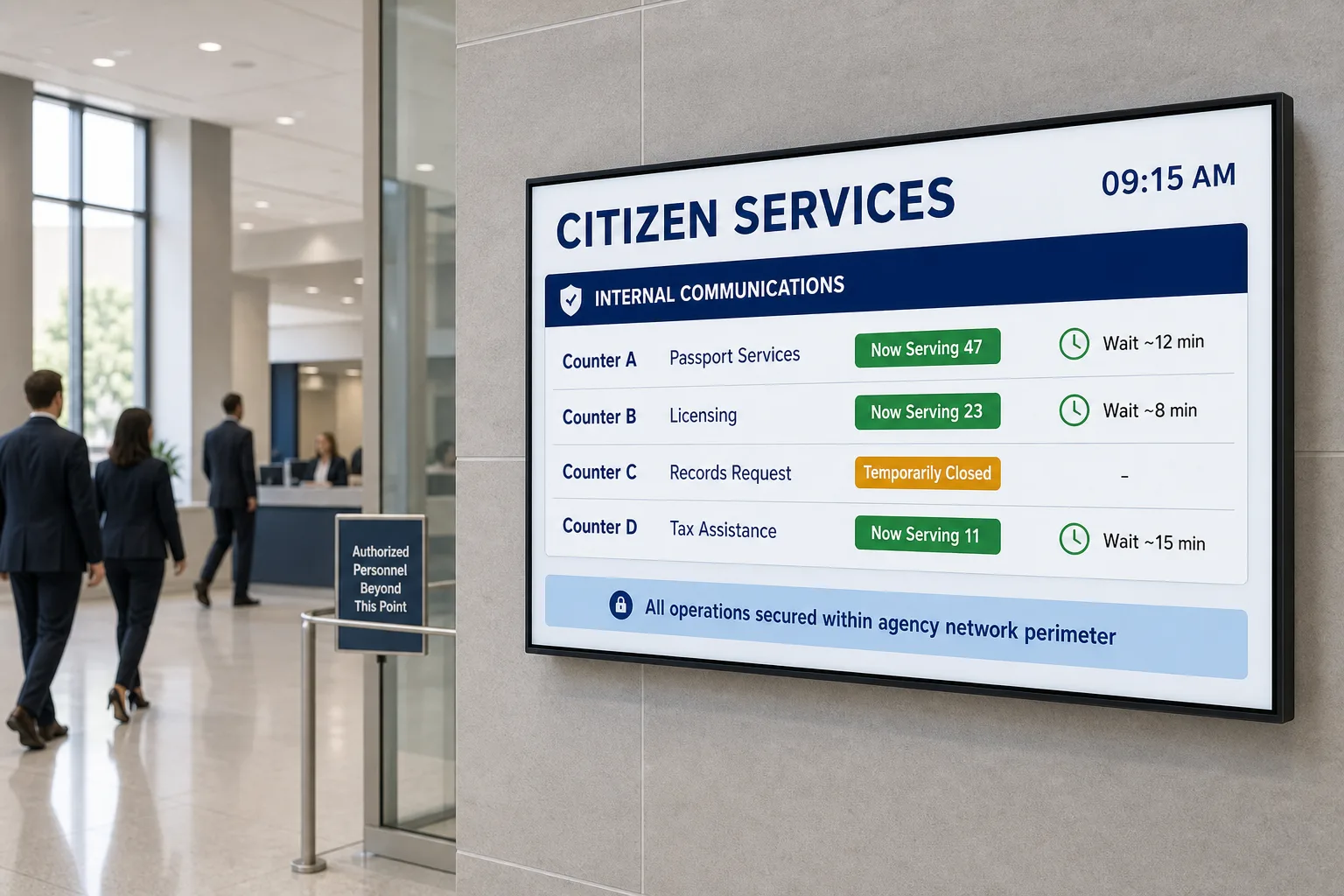
Government and Public Sector
Government agencies managing internal communications, citizen information displays, or operational signage in restricted-access buildings deploy Pickcel on-premise to keep all data within their network perimeter. Learn more about government digital signage.
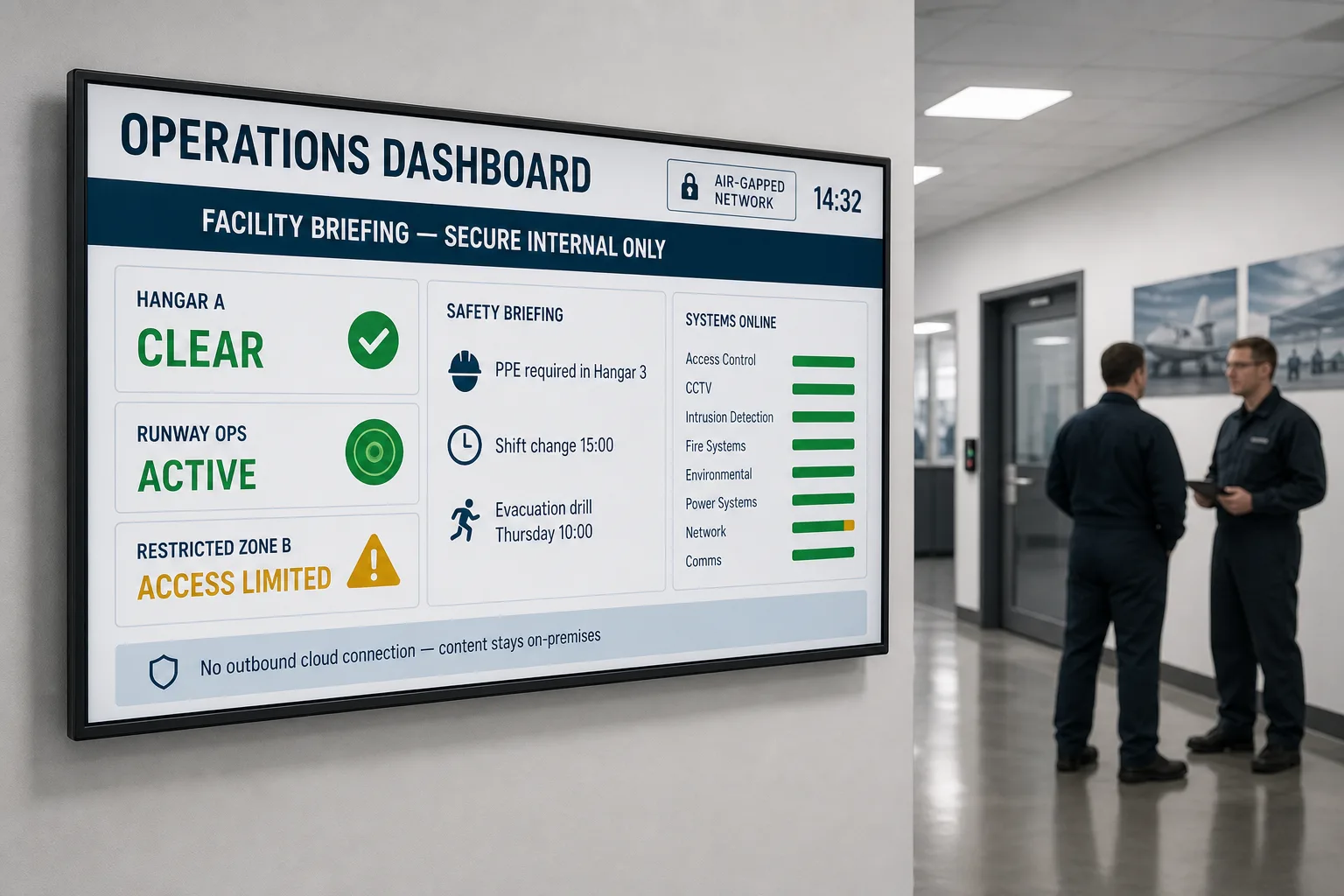
Defence and Aerospace
Facilities operating on classified or air-gapped networks use Pickcel for operations dashboards, safety briefings, and facility-wide broadcasts. Content delivery requires no outbound internet connection, making the platform viable in environments where cloud connectivity is not available.
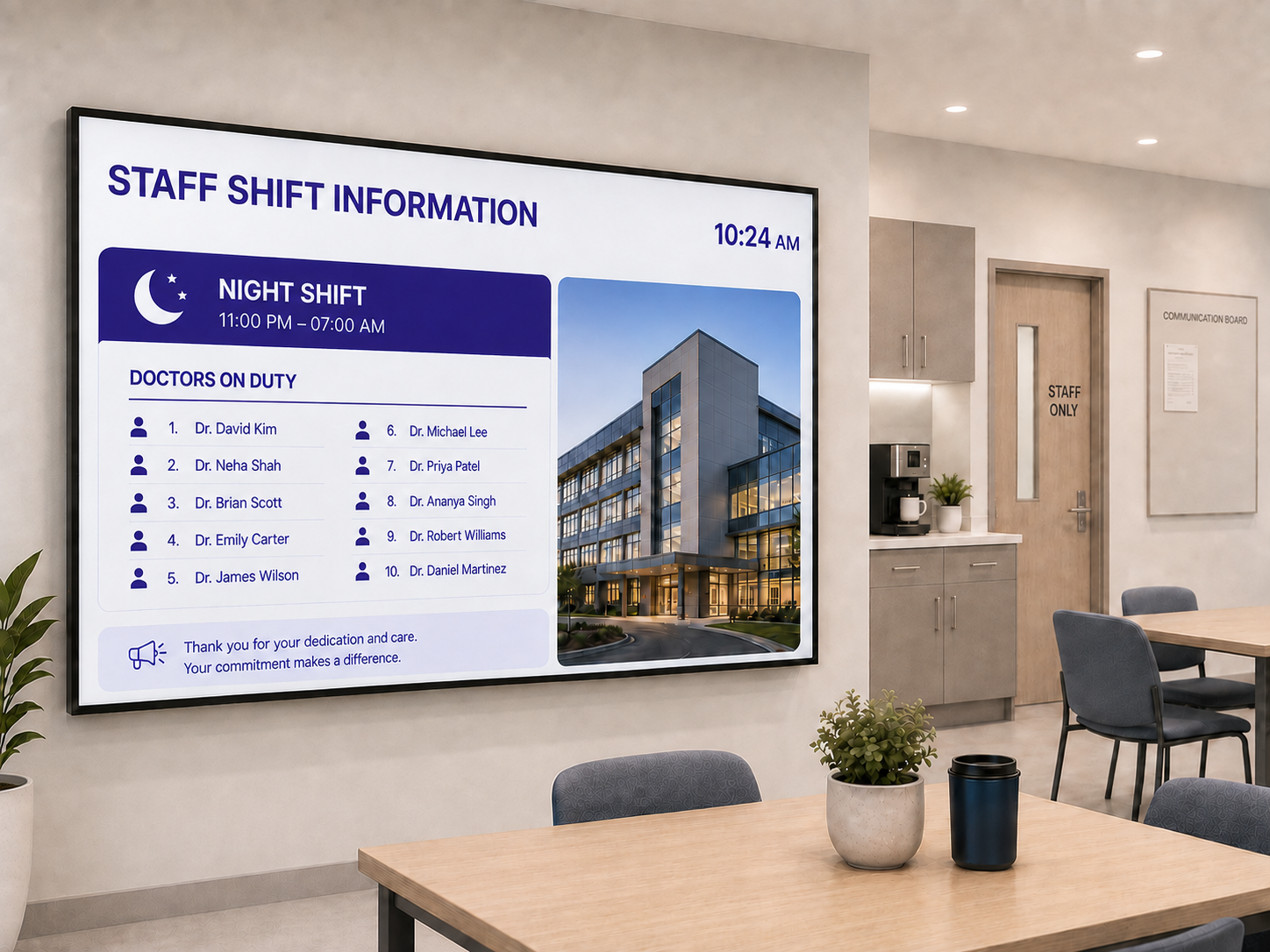
Healthcare and Pharma
Hospitals and pharmaceutical organisations managing patient communication, wayfinding, and regulatory compliance signage deploy on-premise to address data residency requirements. Patient-adjacent data does not leave the organisation's own infrastructure.
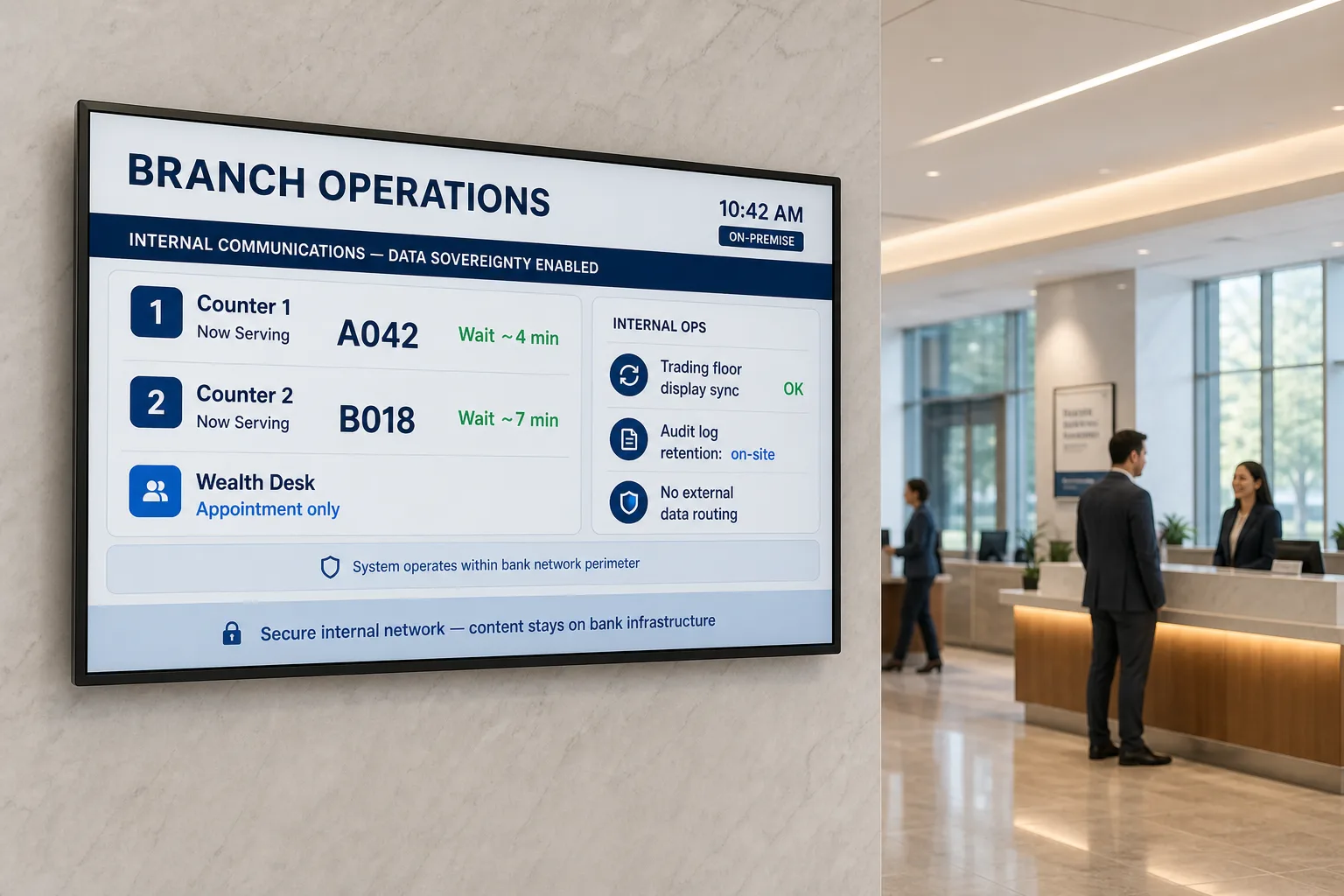
Banking and Finance
Branch communication, trading floor displays, and internal operations signage in banking environments benefit from on-premise deployment when data sovereignty obligations and internal audit requirements apply to all systems generating operational data.
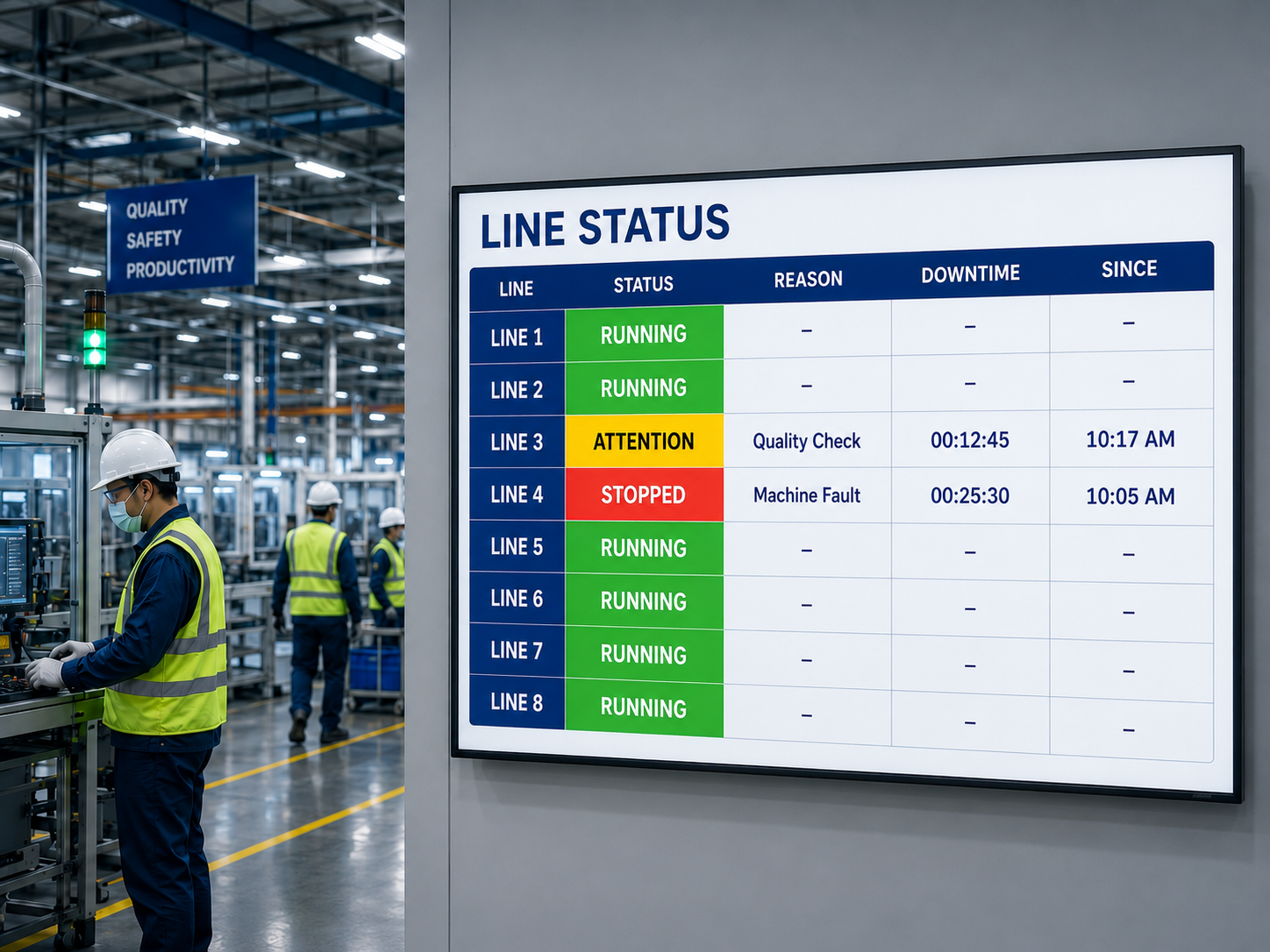
Manufacturing
Production KPI displays, safety alert boards, and shift communication screens in plants with SCADA-adjacent infrastructure run on-premise for network isolation. Explore Pickcel's digital signage for manufacturing facilities to see how plants with SCADA-adjacent infrastructure deploy these displays entirely on-premise.
On-Premise or Cloud-Based: Choosing the Right Deployment
| Decision area | Cloud-based digital signage | On-premise digital signage |
|---|---|---|
| Data location | Vendor-managed cloud infrastructure | Your own servers or private cloud |
| Internet dependency | Required for synchronisation | Not required for content delivery |
| Active Directory / SSO | External API-based integration | Direct internal network integration |
| Compliance fit | Vendor certifications, shared responsibility | Your IT controls audit scope and data residency |
| Deployment complexity | Minimal — vendor manages infrastructure | IT setup required; Pickcel provides deployment support |
| Maintenance | Vendor handles updates and uptime | IT manages updates on your own schedule |
| Suitable for air-gapped environments | No | Yes |
Most organisations choosing on-premise digital signage do so because their security, compliance, or network requirements make cloud routing unacceptable — not because the cloud product lacks capability. Both deployment models deliver the full Pickcel content management platform. For a full total cost of ownership comparison between cloud and on-premise digital signage deployments, see our TCO calculator guide.
On-Premise Digital Signage: Common Questions
Still have questions?
Our team is here to help with anything not covered above.
You Might Also Find Useful

Best On-Premise Digital Signage Software for Enterprise
Compare vendors for regulated, air-gapped, and enterprise on-premise rollouts
On-Premise Digital Signage System Design
How to design a scalable on-premise signage network
10 Benefits of On-Premise Digital Signage for Regulated Industries
Practical benefits for compliance-driven environments

Cloud to On-Premise Migration Checklist
10-step checklist for teams moving from cloud to local infrastructure
On-Prem Digital Signage Deployment Checklist
Pre-launch verification for IT teams