Digital Signage for Convenience Stores: Update Every Promotion in Seconds
Pickcel is a cloud-based digital signage platform that lets convenience store operators create, schedule, and push content to any in-store screen from a single location to a multi-site regional chain. No IT team required.

9,000+
Businesses worldwide
150,000+
Screens managed
70+
Countries
50+
Device types
Convenience Store Digital Signage — At a Glance
Digital signage for convenience stores is a network of connected screens that lets c-store operators update fuel prices, food menus, and promotions remotely in seconds, replacing printed signage with live, updatable content managed from one dashboard across any number of locations.
Key facts
- Update any screen instantly from a phone or browser. No staff on-site required.
- One in five c-store shoppers makes an unplanned purchase on every visit (NACS Convenience Voices, 2023)
- Pickcel supports 50+ device types and works with any flat-screen TV. No new hardware required.
- Free plan available for single-screen deployments; paid plans scale by screen count
What Is Convenience Store Digital Signage?
Convenience store digital signage is a network of connected screens that displays live, updatable content including fuel prices, food menus, promotional offers, and compliance notices. Pickcel lets operators update every screen remotely from any device, replacing printed posters with content that changes the moment you need it to.
Convenience store digital signage replaces printed posters, static price boards, and chalkboard specials with connected screens that show live, changeable content.
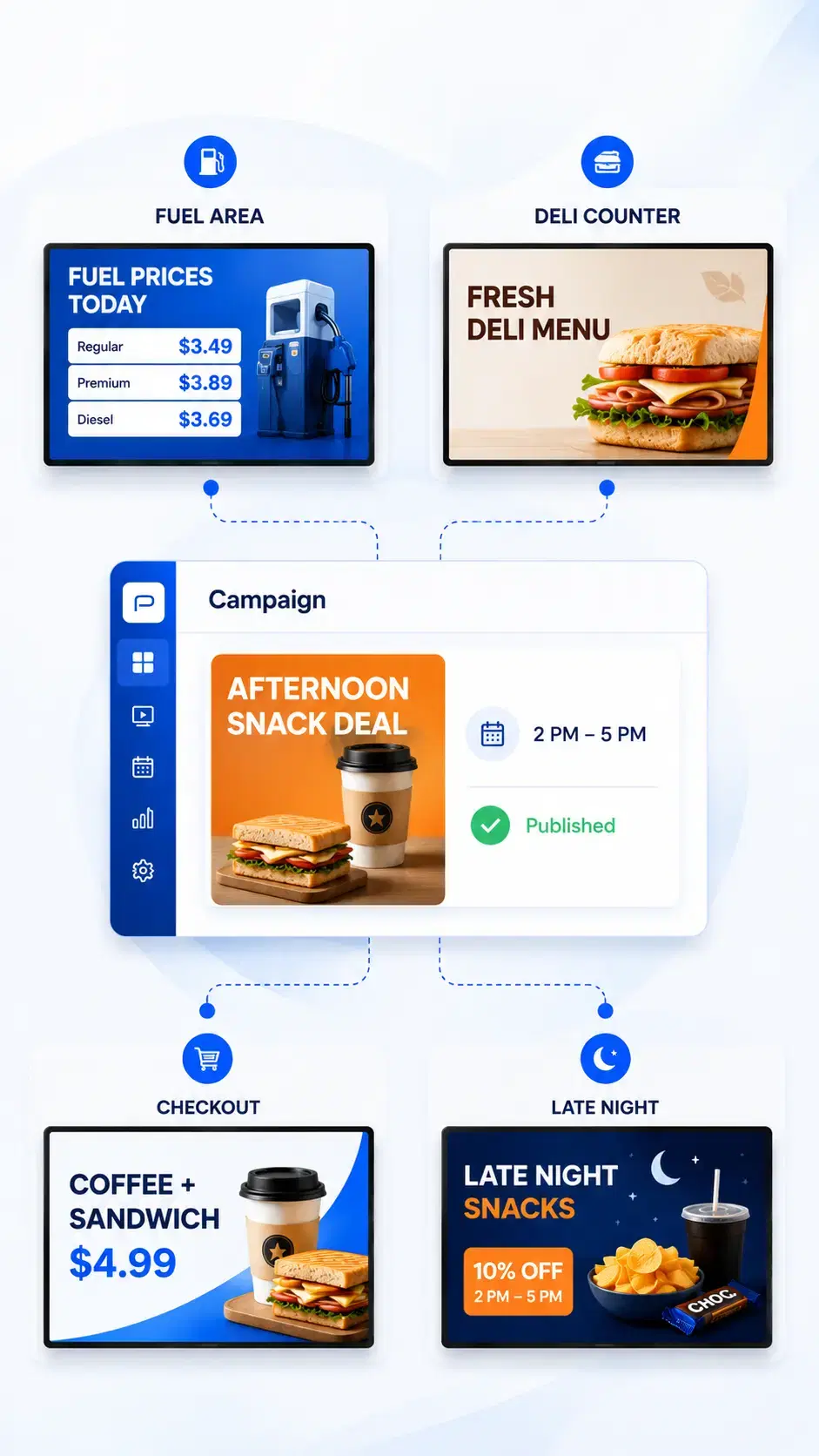
C-store operators use it to display fuel prices at the forecourt, prepared food menus at the deli counter, limited-time promotions near checkout, and compliance notices beside regulated products. Unlike printed materials, content updates the moment you publish a change, from a phone, tablet, or browser, without anyone touching the screen.
For single-location independents and regional chains, that means every store shows the right offer at the right time, without reprinting, reshipping, or sending staff to swap signs—all managed from one digital signage platform.
Why Do Convenience Stores Use Digital Signage?
Convenience stores use digital signage because printed promotions cannot keep pace with c-store operations. Fuel prices shift multiple times a week, food offers rotate daily, and an out-of-date sign at the checkout means a missed impulse sale in the moments that matter most.
Promotion timing
Printed point-of-sale materials take days to produce and arrive. By the time a new offer reaches the shelf, the sales window has often closed. Digital screens update in seconds, so every promotion is current the moment you need it live.
Multi-location inconsistency
Running 10 stores on printed signage means 10 versions of the truth: different prices, outdated stickers, missing offers. Pickcel lets you push the same update to every location at once, or target individual stores with location-specific content.
Staff burden
Each time a poster needs changing, a staff member steps away from the register. Digital signage removes that task entirely. Content updates happen remotely, so the team stays where it belongs.
Printed Signage vs. Pickcel Digital Signage
| Capability | Pickcel Digital Signage | Printed Signage |
|---|---|---|
| Update speed | Seconds (remote publish) | Days (print + ship + install) |
| Multi-location consistency | One update reaches all locations | Manual per-store coordination |
| Staff time required | No (content managed remotely) | Yes (install, change, and dispose) |
| Scheduling and dayparting | Automated start/end times | Not possible |
| Cost per content change | No incremental cost | Print production + logistics |
| Compliance retraction | Instant update from dashboard | Requires physical removal |
What Can You Display in a Convenience Store?
Convenience store digital screens can display fuel prices and forecourt promotions, prepared food menus, tobacco and alcohol compliance notices, loyalty program offers, QR codes, limited-time snack and beverage deals, and supplier co-op ad campaigns. All content can be scheduled or updated in real time from the Pickcel dashboard.

Fuel prices and forecourt promotions
Display current fuel prices inside the store or near the pump canopy. Update them the moment wholesale costs shift, with no manual sign changes and no staff trips across the forecourt.

Food service and hot deli menus
Digital menu boards for prepared food, hot drinks, and daily specials. Use dayparting to switch automatically from breakfast items in the morning to hot deli at lunch, without any manual changeover.
Tobacco and alcohol compliance notices
Show age verification requirements, product warnings, and regulatory messaging on screens near restricted products. Update compliance content the moment regulations or store policies change.
Loyalty program offers and QR codes
Promote sign-up incentives, member-exclusive prices, and app download prompts with scannable QR codes. Customers act without needing staff assistance.
Limited-time beverage and snack promotions
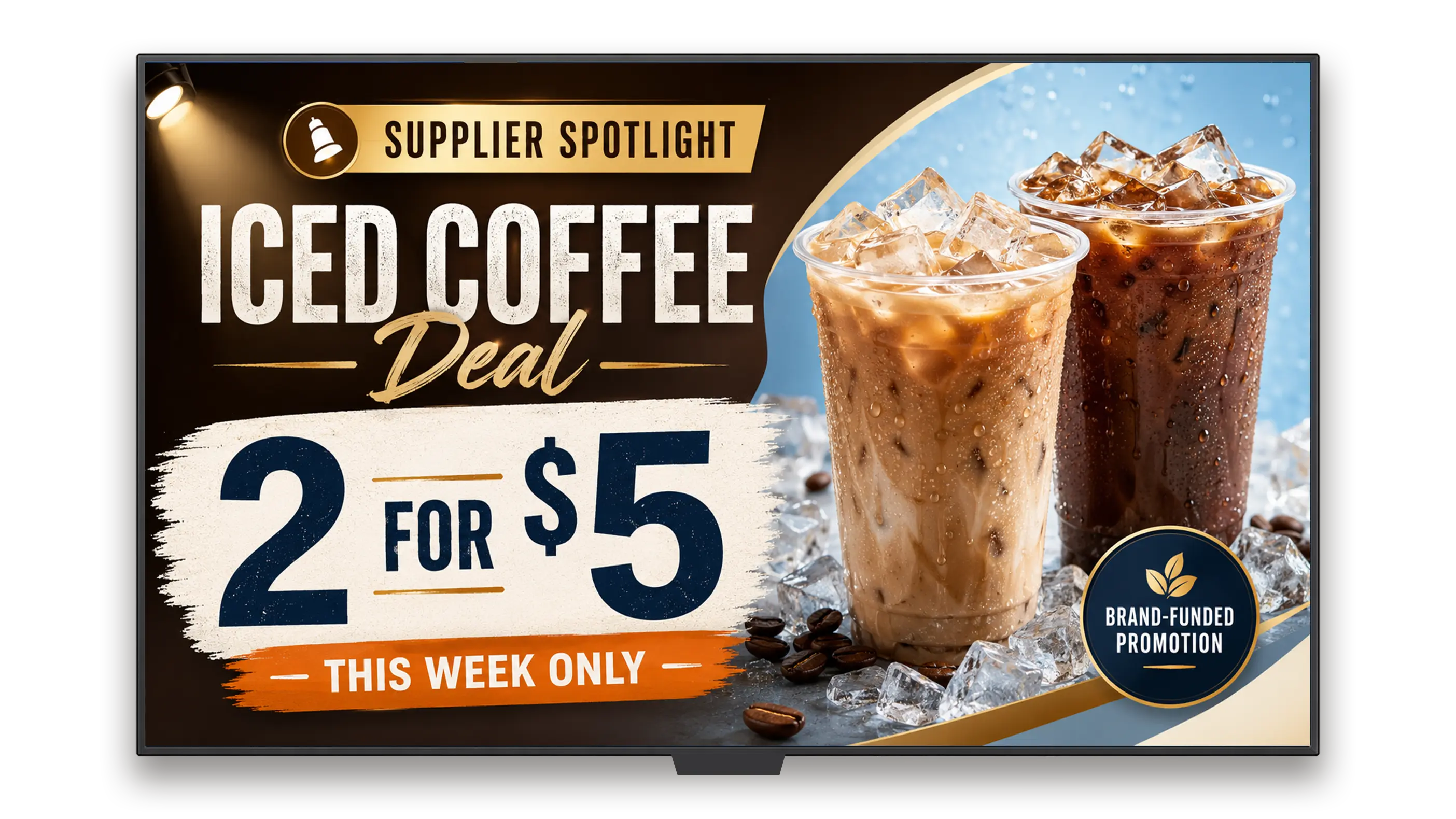
Schedule time-boxed deals to start and end automatically. A "2pm coffee promotion" goes live at 2pm and expires at 5pm without anyone touching a screen.
Supplier co-op and brand campaigns
Run brand-funded content from your beverage, snack, or tobacco suppliers on the same system you use for everything else. No second device. No separate login.
How Does Pickcel Work in a Convenience Store?
Setting up Pickcel in a convenience store takes three steps: connect a media player to any flat-screen TV, register the screen in the Pickcel dashboard, then push content from a phone or laptop. Most stores are live within 15 minutes. No IT team needed.
Connect your screen
Plug a compatible media player (Android stick, Amazon Fire TV Stick, or your existing Samsung or LG smart display) into any flat-screen TV in the store. If the screen has an HDMI port, it works.
Set up your account
Sign up for Pickcel and register your screen from the web dashboard or the mobile app. Name it, assign it to a playlist or content zone, and it's live. First screen setup takes under 10 minutes.
Publish and update from anywhere
Use Pickcel's template library to build content, or upload your own designs. Push updates to one screen, one store, or every location at once from any browser or the Pickcel mobile app. When a promotion changes, update it in the same place.
See How It Works
What Features Matter Most for C-Store Digital Signage?
The four features that matter most for convenience store operators are real-time remote updates, dayparting and scheduling, multi-location management, and a ready-to-use template library. These directly address the speed, consistency, and staffing constraints unique to c-store operations.
Real-time remote updates
Feature: Update any screen instantly from a phone or browser.
Advantage: No physical access to the store, no print production cycle, no waiting.
A price change published at 7am is visible on every screen at 7am, not two days later.
Scheduling and dayparting
Feature: Set content to activate and expire automatically on a schedule.
Advantage: Breakfast, lunch, and evening promotions switch themselves. Flash offers end on time without manual intervention.
Staff focus on customers, not content clocks.
Multi-location management
Feature: One dashboard controls all screens across every location.
Advantage: Push one update to 5 stores or 50 simultaneously. Target individual stores with local pricing while keeping regional campaigns consistent.
Brand consistency across your entire network, without per-store coordination.
Template library
Feature: Pre-built layouts for food menus, price boards, compliance notices, and promotional displays.
Advantage: Non-designers produce professional-looking content in minutes.
Any staff member can update a promotion without calling head office for a new graphic.
The Business Case for In-Store Digital Signage
According to NACS Convenience Voices research published in May 2023, one in five c-store shoppers makes an unplanned purchase on every visit, rising to one in four during late-night hours. Among those shoppers, eye-catching displays drove impulse purchase decisions for nearly 20% of respondents, second only to the product's visual appeal.
That context matters for what you put on screen. A rotating promotion near the deli counter reaches a customer who came in for fuel with no food purchase planned. Static printed posters carry that message once, then fade into the background. Digital screens cycle, refresh, and stay relevant by design.
For multi-location operators, there is a second case: time and coordination. Managing print-based promotions across 10 or more stores involves print production, shipping logistics, and per-store staff time for installation. C-store operators who move to cloud-based digital signage consistently report meaningful reductions in that overhead, though the savings vary by operation size and how promotions were managed before.
For ROI context, see retail digital signage ROI.
Key takeaway: The impulse purchase window (the seconds between a customer noticing a screen and reaching the checkout) is where c-store digital signage pays for itself. Content that updates in real time, matched to time of day and store context, captures sales that static printed materials cannot.

What Hardware Works with Pickcel in Convenience Stores?
Pickcel works with Android media players, Amazon Fire TV Stick, Samsung SSSP displays, LG webOS screens, Windows PCs, and ChromeOS devices. It connects to any flat-screen TV with an HDMI input, so most convenience stores can get started with screens they already own, no proprietary hardware required.
You do not need proprietary screens or a new hardware investment to get started. If the store already has flat-screen televisions, they will work.
For new installations, an Android media player or Amazon Fire TV Stick connects to any existing TV via HDMI. Samsung SSSP and LG webOS commercial displays run Pickcel natively without any external device. Pickcel's digital signage software supports 50+ device types and runs over Wi-Fi or a wired LAN connection.
Offline playback keeps content running if the internet drops, so screens stay active during connectivity interruptions, without blank screens or error messages.
Any flat-screen TV with an HDMI input works with a compatible media player — no proprietary hardware or locked-in equipment purchasing required.
Enterprise-Grade Security for Multi-Location Retail
Pickcel is trusted by retailers, QSR operators, healthcare networks, and enterprise teams across more than 70 countries. SOC 2 Type II and ISO 27001 certifications mean IT and security teams at multi-location operators can approve deployment quickly and without extended review cycles.
SOC 2 Type II Certified
Independent audited certification confirming Pickcel's security, availability, and confidentiality controls meet enterprise Trust Services Criteria.
ISO 27001 Certified
Pickcel's information security management system is certified to ISO 27001, the internationally recognised standard for information security practices.
Role-Based Access + Audit Logs
Store managers control their location's screens while regional and head-office teams retain network-wide visibility. Full audit logs capture every change with user and timestamp.
Multi-location operators evaluating Pickcel against internal security policies can request compliance documentation. Details on Pickcel's security and compliance certifications are available on request.


What Retail Operators Say About Pickcel
Operations Manager
·Regional Convenience Retailer
See how Exprezo uses Pickcel for retail digital signage