
Workplace Safety Communication Systems: Technology Comparison 2026
Compare workplace safety communication systems for multi-channel emergency alerts, OSHA compliance, acknowledgment tracking, and zero-miss safety messaging. This guide breaks down channel performance, outlines six technology requirements, and includes a 20-point vendor evaluation checklist so you can modernise safety communication with confidence.

TL;DR
- What this covers
- Comparison of workplace safety communication channels, OSHA compliance requirements, acknowledgment tracking systems, and a 20-point vendor evaluation checklist.
- Bottom line
- Multi-channel systems achieve 98% message delivery vs. 76% for single-channel approaches — a gap that directly correlates with incident rates and OSHA exposure.
- Key finding
- 48% of workplace incidents involve communication as a contributing factor; 67% of repeat incidents involved no change to the communication method after the first event.
- Who should read this
- EHS Officers, Safety Managers, Plant Managers, and Facility Directors evaluating or upgrading workplace safety communication platforms.
Who Needs This
The Impact
98%
Multi-Channel Message Delivery
vs 76% for single-channel approaches
31%
Fewer Preventable Incidents
when 3+ coordinated channels are deployed
40–60%
Faster OSHA Resolution
with acknowledgment audit trails
When a forklift punctured a chemical storage rack at a 450-person manufacturing facility, the safety manager immediately sent an email alert. Thirty minutes later, three workers were treated for respiratory exposure — not because the warning was not issued, but because 63% of employees in the affected building had no reason to check their inbox mid-shift. The incident cost the organisation over $210,000 in direct and indirect costs. The root cause was not chemical storage. It was a single-channel communication system.
This guide compares workplace safety communication technologies — digital signage, desktop alerts, mobile push, SMS, and PA systems — across delivery speed, reliability, acknowledgment capability, and OSHA compliance. Use it to assess your current setup or evaluate vendor options before your next platform decision.
The OSHA Framework Establishes Minimum Safety Communication Standards
OSHA 29 CFR 1910.145 requires employers to ensure all affected employees receive, understand, and have access to safety information at all times — and modern compliance officers increasingly evaluate whether digital communication systems satisfy that intent, not just the letter of a regulation written before the digital workplace existed.
Understand the Legal Baseline
The standard mandates that safety information be visible at all times to affected employees, understandable regardless of language or literacy level, and supported by documentation proving that communication occurred. A bulletin board in a break room no longer satisfies "visible at all times" when employees spend most of their shift on a production floor — a distinction OSHA compliance officers now apply with increasing rigour during post-incident investigations.
Define What Qualifies as a Safety Communication System
A workplace safety communication system is a technology platform that delivers critical safety information through multiple channels with delivery confirmation, ensuring zero-miss reach for life-safety messages. Five characteristics define a compliant modern system: multi-channel delivery, priority message routing, delivery confirmation, employee acknowledgment capability, and audit-ready compliance documentation. Systems lacking any of these five elements expose organisations to regulatory and liability risk.
Communication Failures Drive 48% of Preventable Workplace Incidents
The most preventable driver of workplace incidents is the failure to communicate hazard information to the right people at the right time. According to OSHA incident analysis data from 2021–2025, 48% of workplace incidents involved communication as a contributing factor — a statistic that points directly to systems, not individual negligence.
⚠️ WARNING
67% of repeat incident scenarios involved no change to the communication method after the first incident — meaning organisations knowingly maintained a failed system and incurred a second preventable cost. Repeated OSHA violations carry penalties of up to $161,323 per instance, classified as willful violations.
The financial consequences extend well beyond regulatory fines. A lost-time injury averages $42,000–$65,000 in direct costs (workers' compensation, medical treatment, OSHA penalties). Severe injuries or amputations range from $380,000 to $1.2 million. Critically, direct costs represent only 25–30% of total incident cost — indirect costs including investigation time, production downtime, insurance premium increases over three years, and replacement worker training are typically 3–4 times the direct expense.
The implication is direct: a preventable incident carrying $65,000 in direct costs will typically reach $195,000–$260,000 when all downstream consequences are accounted for. A modern multi-channel safety communication platform costs a fraction of a single preventable incident.
Six Technology Requirements Define Effective Safety Messaging Systems
Effective workplace safety communication is not determined by the number of channels deployed — it is determined by whether those channels collectively guarantee that every affected employee receives, views, and confirms understanding of critical messages. The following six requirements separate genuinely compliant systems from those that only appear to.
Ensure Sub-10-Second Emergency Delivery
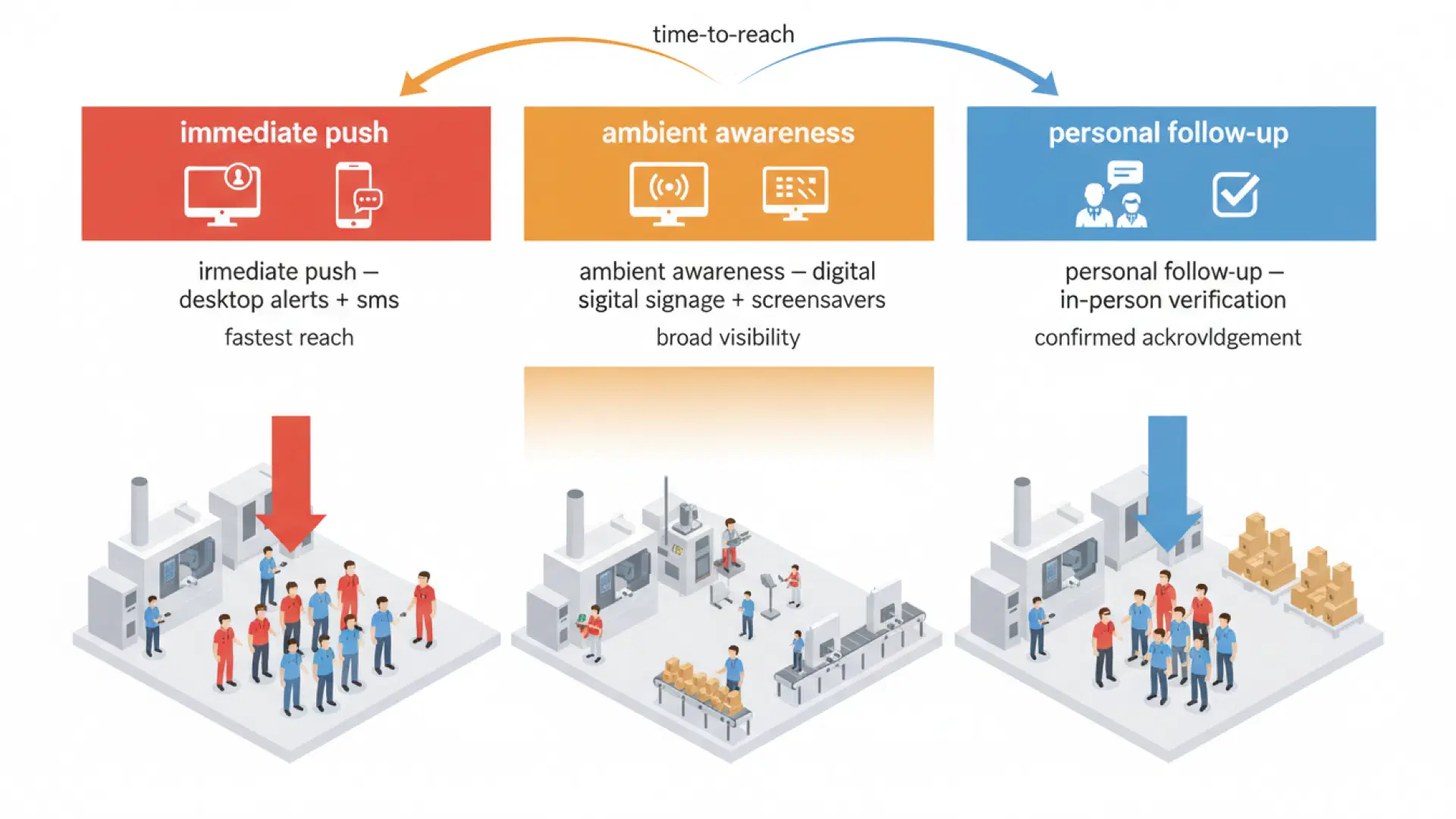
Emergency scenarios — chemical spills, gas leaks, equipment failures, active threats — are measured in seconds. Desktop alerts deliver to logged-in employees in under 5 seconds; digital signage overrides scheduled content instantly; SMS reaches mobile workers within 30 seconds. Email, which averages 7–15 minutes to reach recipients, is not an emergency communication channel. Treating it as one is a documented contributing factor in multiple OSHA-cited incidents.
Deploy Minimum Three-Channel Redundancy
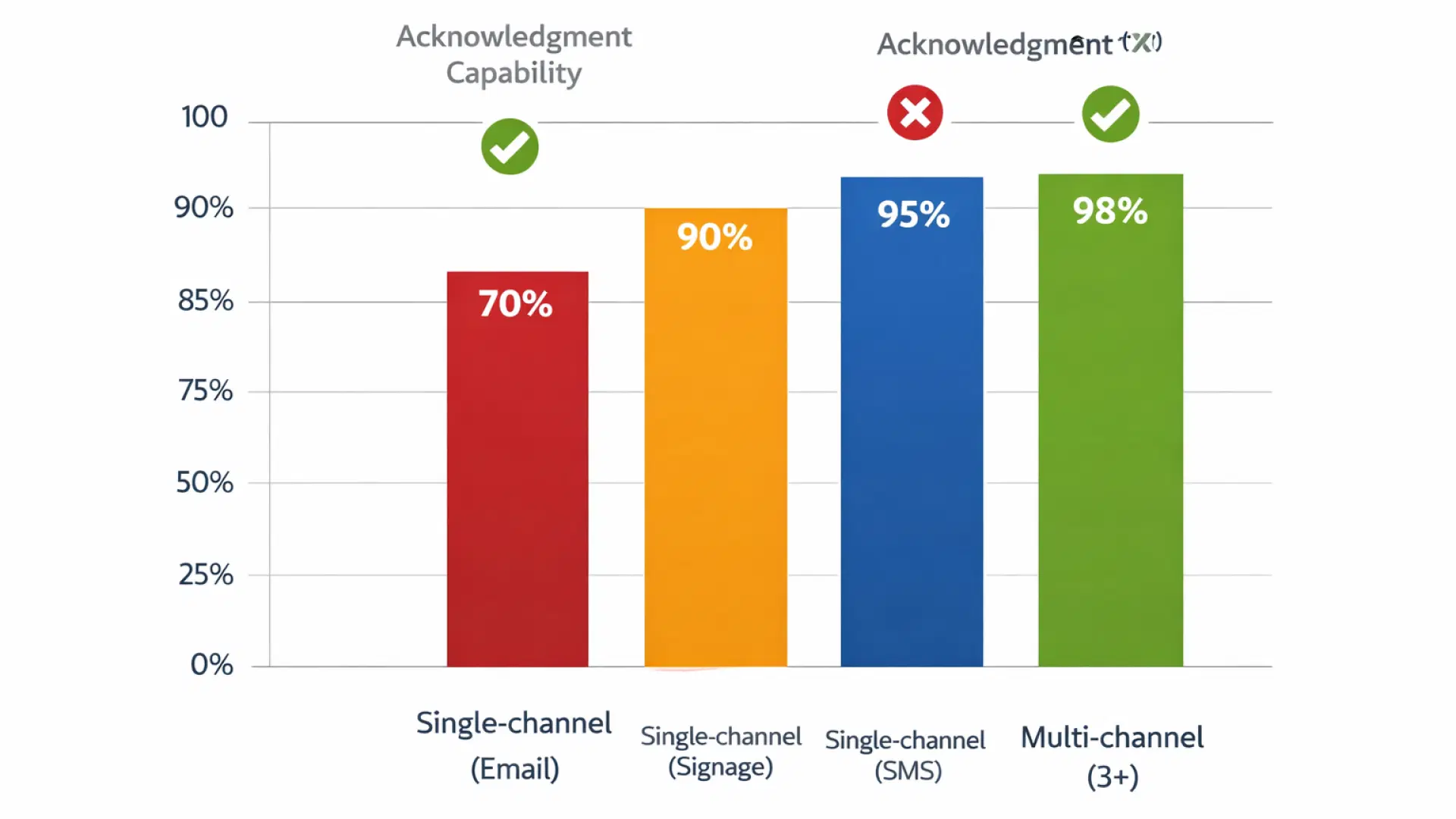
No single channel achieves reliable reach across an entire workforce. Email delivers to 76% of recipients under ideal conditions. Digital signage reaches only employees physically near screens. SMS requires mobile signal and opt-in registration. Multi-channel systems combining desktop alerts, digital signage, and SMS consistently achieve 98% delivery rates — eliminating the single-point-of-failure risk that leaves one in four employees uninformed during a critical event.
Implement Priority Override Across All Channels
Critical safety messages must interrupt current activity. P1 (life-safety) alerts should trigger full-screen desktop interruptions, override all scheduled digital signage content, push SMS simultaneously, and bypass device-level Do Not Disturb settings. Routine safety reminders and emergency alerts must operate on distinct priority tiers — alert fatigue from over-interruption directly reduces acknowledgment rates when genuine emergencies occur.
Capture Acknowledgment at the Employee Level
Delivery confirmation (the message reached the device) is not the same as acknowledgment (the employee actively confirmed understanding). For OSHA compliance, acknowledgment is the strongest evidence available. Desktop alerts capture click-based acknowledgment with timestamps; digital signage uses QR code or badge-tap scanning; SMS requires a reply confirmation. Systems that only log delivery provide significantly weaker compliance protection during post-incident investigations.
Target Delivery by Zone, Role, and Shift
An ammonia leak in Building 3's east wing should alert employees currently in that zone, maintenance and safety response teams, active contractors in the area, and workers scheduled to enter within the next 60 minutes — not trigger a facility-wide broadcast that creates confusion and erodes urgency. Effective systems support geographic zone targeting, role-based distribution, and shift-specific delivery as standard capabilities.
Integrate with Building Safety Infrastructure
Automated triggering from connected sensors eliminates the 30–60 second human delay between hazard detection and first notification. Fire alarm systems, gas sensors, access control platforms, and HVAC fault detection can all serve as triggers — initiating coordinated communication across all channels without manual intervention. That 60-second reduction in response time consistently determines the difference between safe evacuation and exposure.
Channel Performance Data Reveals Multi-Channel Superiority
No single channel achieves reliable emergency reach — and the performance gaps are large enough that choosing the wrong primary channel leaves more than one-third of a workforce uninformed during a critical incident. The table below compares the six most common workplace safety communication channels across the criteria that matter most. For teams deploying screens across multiple sites, digital signage software with built-in emergency override and remote management is the foundation of an effective safety communication system.
Safety Communication Channel Performance Comparison
| Channel | Speed | Max Reach | Emergency Override | Acknowledgment | Key Limitation |
|---|---|---|---|---|---|
| Desktop Alerts | <5 sec | 98% (online) | ✓ | ✓ (click + timestamp) | Requires logged-in device |
| Digital Signage | Instant | 90% (in-area) | ✓ | ✓ (QR / badge scan) | Physical proximity required |
| SMS / Mobile Push | <30 sec | 95% | ✓ | ✓ (reply confirmation) | Signal + opt-in required |
| 7–15 min | 70% | ✗ | ✗ | Too slow for emergencies | |
| PA Systems | Instant | 85% (audible) | ✓ | ✗ | Audio only; no confirmation |
| Microsoft Teams | 1–3 min | 80% | ✗ | Limited | Notification fatigue risk |
Source: Pickcel analysis of 200+ enterprise deployments and OSHA incident data, 2024–2025.
The most critical gap in this data is acknowledgment coverage. Four of the six channels above provide zero confirmation that an employee received or understood a critical safety message. Without acknowledgment records, organisations cannot demonstrate to OSHA investigators that they fulfilled their duty to inform affected workers — a documentation failure that significantly shifts liability exposure and average penalty severity.
"The question I ask every facility is straightforward: if an emergency happened right now, how many employees would know within 60 seconds — and how many of those could you prove received the message? Most organisations cannot answer either."
— James Holbrook, Senior EHS Consultant, National Safety Council
Acknowledgment Tracking Closes the Gap Between Delivery and Understanding
Acknowledgment tracking transforms safety communication from a broadcast activity into a verifiable compliance function — the operational difference between saying you informed employees and being able to prove it during an OSHA investigation.
Verify Three Distinct Levels of Message Receipt
There are three verification levels: (1) delivery confirmation — the message reached the device; (2) receipt confirmation — the employee was exposed to it; (3) acknowledgment confirmation — the employee actively confirmed understanding. OSHA investigations rely on Level 3 evidence. Desktop alerts capture click-based acknowledgment with timestamps; digital signage uses QR code or badge scanning; SMS requires a reply confirmation. Systems that only log delivery (Level 1) provide the weakest compliance protection available.
Implement Escalation Protocols for Non-Responders
Missing acknowledgments must trigger automated escalation: a reminder at 30 minutes for non-emergency messages, supervisor notification at 60 minutes, and in-person verification for persistently unreachable employees. Every escalation attempt must be logged with timestamps and method. Without this documentation trail, organisations cannot demonstrate due diligence during regulatory review of an incident involving an employee who claimed not to have received a critical warning.
System Integration Enables Automated Emergency Response
Automated alert triggering — initiated by connected sensors rather than a human operator — consistently delivers first notifications 30–60 seconds faster than manually initiated emergency communication. In chemical, fire, or active-threat scenarios, those seconds determine outcomes.
📌 KEY INSIGHT
Facilities with sensor-integrated safety communication report first alert delivery within 10 seconds of hazard detection, compared to 40–70 seconds for manual notification workflows. According to Pickcel's analysis of 200+ enterprise deployments, automated triggering is the single feature most correlated with zero-exposure incident outcomes.
Effective integration connects the safety communication platform to building management systems (HVAC fault detection, temperature excursions, water leak detection), fire alarm systems for zone-specific evacuation coordination, gas and environmental sensors for chemical and combustible-gas thresholds, and access control platforms for lockdown scenarios. Two-way integration allows the system to confirm message delivery back to the triggering source, creating a closed-loop emergency response record that satisfies both operational and compliance requirements.
Compliance Documentation Must Satisfy OSHA Audit Standards
When OSHA compliance officers conduct post-incident investigations, they evaluate three evidence categories: proof that communication occurred (date, time, message content); proof that affected employees received it (delivery method, distribution list); and — for critical safety procedures — proof that employees understood the message (acknowledgment records, comprehension verification). Organisations unable to produce all three categories face significantly higher penalty severity and longer case resolution timelines.
Compliant systems must support a minimum five-year retention of all safety communication records, with search and filter capability by employee ID, date range, incident type, and communication channel. Export functionality in PDF or CSV format for OSHA inspection requests is non-negotiable. Records related to specific incidents should be retained for the duration of any associated legal action plus five years.
💰 ROI SNAPSHOT
Organisations with complete acknowledgment documentation during OSHA investigations report 40–60% faster case resolution and lower penalty outcomes. A single willful violation penalty of $161,323 exceeds the three-year total cost of most enterprise safety communication platforms — making compliance documentation infrastructure one of the highest-ROI line items in any EHS programme.
A 20-Point Checklist Guides Technology Vendor Evaluation
Use this structured checklist to evaluate any safety communication platform before procurement. P1 items are non-negotiable for OSHA compliance; P2 items differentiate platforms across use cases and scale requirements.
Essential Capabilities — Must-Have (P1)
| Requirement | Evaluation Criteria | Priority |
|---|---|---|
| Multi-channel delivery | Desktop alerts + digital signage + mobile (minimum 3 channels) | P1 |
| Emergency override | Interrupts scheduled content and device-level Do Not Disturb instantly | P1 |
| Acknowledgment tracking | Employee-level confirmation with timestamps and escalation workflows | P1 |
| Targeted delivery | Zone-based, role-based, and shift-specific message targeting | P1 |
| Sub-10-second delivery | Verified <10 seconds for emergency alert deployment across all channels | P1 |
| Integration APIs | Connects to BMS, fire systems, access control, and gas detection sensors | P1 |
| Audit trails | Full delivery and acknowledgment logs, export as PDF/CSV for OSHA inspections | P1 |
| Role-based access | Safety teams send alerts; general employees cannot broadcast | P1 |
| Multi-language support | Safety messages displayed in employee-preferred languages automatically | P1 |
| Offline message queuing | Messages queue and deliver when employee device reconnects | P1 |
| 99.9%+ uptime SLA | Non-negotiable availability guarantee for life-safety communication systems | P1 |
Advanced Capabilities — Differentiation (P2)
| Requirement | Evaluation Criteria | Priority |
|---|---|---|
| Automated sensor triggers | Hands-free emergency initiation from connected safety sensors | P2 |
| Geo-fencing | Location-based alerts for large campuses or multi-building facilities | P2 |
| Rich media support | Images or video for complex safety procedure communication | P2 |
| Drill scheduling tools | Built-in testing with documented delivery results for compliance records | P2 |
| Analytics dashboard | Reach rates, acknowledgment rates, and channel performance metrics | P2 |
| Escalation workflows | Automated supervisor notification for employees who do not acknowledge | P2 |
| Two-way hazard reporting | Employees report hazards through the same system used to receive alerts | P2 |
| SOC 2 Type II certification | Data security and system availability standards independently verified | P2 |
| Vendor implementation support | Assisted configuration, integration setup, and admin training included | P2 |
Executive Summary
Forty-eight percent of workplace incidents involve communication failures — and most of those failures are systemic, not accidental. Organisations that rely on email, bulletin boards, or PA systems as their primary safety channel leave 15–38% of their workforce unreachable during the moments that matter most. Multi-channel safety communication platforms combining desktop alerts, digital signage, screensavers, Teams, WhatsApp, and SMS achieve 98% delivery rates, and paired with acknowledgment tracking, they satisfy OSHA's documentation requirements at every level of evidence.
Three decisions determine the effectiveness of any safety communication system: the channels deployed (minimum three, chosen for complementary reach characteristics), the acknowledgment capability implemented (employee-level confirmation, not just delivery logging), and the integration with existing building safety infrastructure (sensor-triggered automation removes the human delay that determines outcomes in chemical, fire, and active-threat scenarios). Organisations that make these three decisions correctly report fewer incidents, faster regulatory case resolution, and measurably lower total cost of risk.
The question is not whether to invest in modern safety communication technology. It is whether your organisation can absorb the $42,000–$380,000 per-incident cost of preventable events that result directly from communication failures in systems that already exist and could be replaced.
Frequently Asked Questions
Still have questions?
Our team is here to help with anything not covered above.


Transform your safety communication system with a multi-channel platform
Deliver every critical safety message across desktop, mobile, signage, and collaboration channels from a single interface — with 98% reach, acknowledgment tracking, and OSHA-ready audit logs.